Steam Wharf, Galway, c1850
Thu, Mar 18, 2010
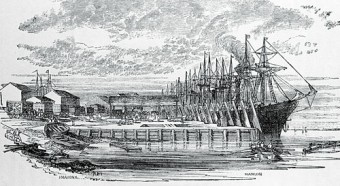
A report on Galway Bay and Harbour published by the House of Commons in 1838 makes for interesting reading.
Read more ...Queen’s College Galway
Thu, Feb 25, 2010
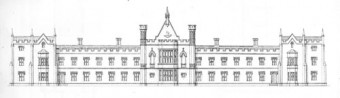
In 1845, when Sir Robert Peel was in office, an act was passed providing for the establishment of three Queen’s colleges “In order to supply the want, which has long been felt in Ireland, of an improved academical education, equally accessible to all classes of the community without religious distinction”. Three faculties were established in each… arts, law, and physic (medicine). The colleges were strictly undenominational, and the professors were forbidden by the statutes to make any statement disrespectful to the religious convictions of their classes, or to introduce political or polemical subjects.
Read more ...Cross country champions from Móinín na gCíseach
Thu, Feb 11, 2010
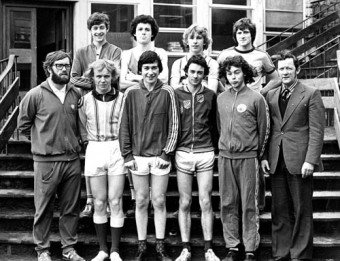
Galway Community College in Móinín na gCíseach opened on September 1 1969. Jack Mahon was the first principal and among the staff were vice-principal Tom Gallagher, Philomena Burke, Joe Rooney, Peter Keady, Seán O’Donnell, Noel Carpenter, Joan Ryan, Myra Ryan, and Philip Cribbin. The aim was to create a caring atmosphere where students were and are encouraged and helped to develop their unique talents and gifts, by providing the academic and vocational skills that enable them to attain their maximum potential and participate fully as good citizens in society.
Read more ...The Castle Hotel
Thu, Jan 28, 2010
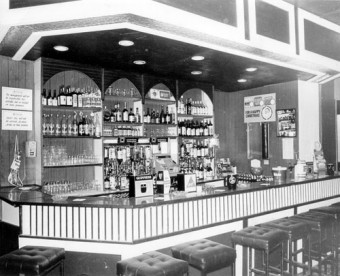
“An important addition to the accommodation for visitors in Galway is provided by the Castle Hotel. This hotel is conveniently situated in Lower Abbeygate Street, opposite the Pro-Cathedral. The proprietors claim that it is not only the newest of Galway’s hotels, but it is also the most comfortable and central tourist, family, and commercial hotel in the city, and with this contention, many who stayed there would fully agree. The Castle Hotel is within a few minutes walk from the railway station and docks. It is fully licensed. Parties are catered for.”
Read more ...A Galway Textile Printers XV
Thu, Jan 21, 2010
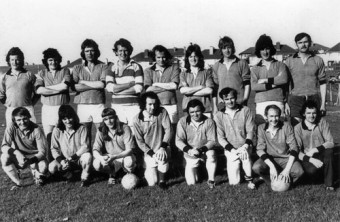
A challenge hurling match and a return game played between Galway Woollen Mills, Newtownsmyth, and the Post Office was the seed that led to the inauguration of an inter-factory hurling competition. A meeting was held in the CYMS in February 1954 and the following committee was elected: Jimmy O’Connor, GPO, chairman; Tommy Connellan, CIE, secretary; Tom Mooney, the Hat Factory; Sean Duggan, ESB; Sean O’Connor, Galway Woollen Mills; Jimmy Duggan, O’Gorman’s; Paddy Purcell, Sisk’s; Mick McGrath, AA Stuart’s; and Cronan Treacy, McDonoughs.
Read more ...The Claddagh market
Thu, Jan 14, 2010
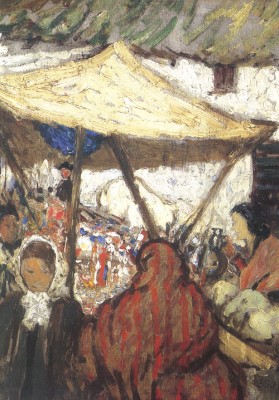
Grace Henry was born in Aberdeen in 1868. She studied art in Paris where she worked with Andre Lhote. It was there she met the Irish artist Paul Henry, and they married in 1903. They returned to Ireland to paint. In 1912 they went on holiday to Achill Island, and ended up staying there for eight years. They both painted a lot on the island, but also in other areas in the west. Her work was very influenced by Paul in those years. Eventually they moved back to Dublin and, in the late 1920s, they separated. They continued to paint and each developed a major artistic reputation. Grace died in 1953.
Read more ...A corner of William Street, c1920
Thu, Jan 07, 2010
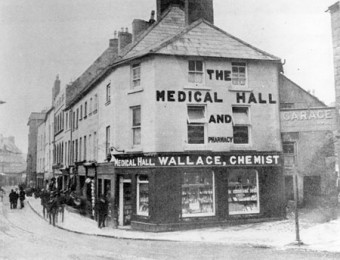
This photograph was originally published in Burrows Guide Book which was printed c1920. The main feature is The Medical Hall and Pharmacy which was owned by AP Wallace. To the right of that you can see the entrance to Higgins’ Garage (he was an agent for Ford cars), and to the right of that again, down a little alleyway, was the entrance to the Empire Theatre.
Read more ...Galway Gaol, April 1958
Thu, Dec 17, 2009
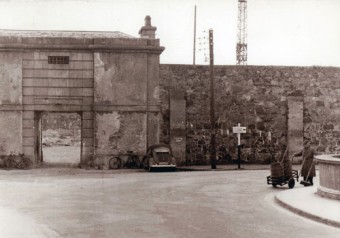
This photograph of the gaol was taken from the Salmon Weir Bridge in April 1958. It looks very bare with no traffic, and that high wall looks very imposing. The road sign we see was pointing to Clifden. The registration number on the Volkswagen car is ZM 3204. Note the bicycles parked at the entrance. The corporation worker with the barrow is ‘Janie’ Carr. As you can see from the crane and the pile of rubble inside the wall, the construction company Sisks had just begun to clear out the space for the building of the cathedral, which of course is on this site today.
Read more ...Some memories of a Galwegian
Thu, Dec 10, 2009
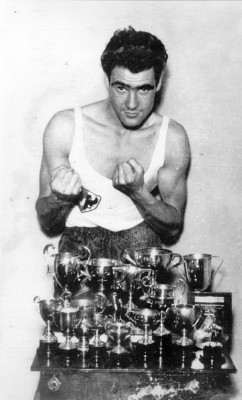
Michael Gillen was born in a house on a corner at Galway Docks in 1933. His family soon moved to Cooke’s Terrace in Bohermore, which he describes as “the best place I have ever lived in... you could not find a bad neighbour”. He had a “massive childhood”, much of it revolving around sport. Two of his great mentors were Tom Fleming and Martin King, both from Bohermore and both All-Ireland winners with the Galway hurling team in 1923. Michael’s dad grew vegetables and potatoes in ‘The Plots’ on the Headford Road, and his mother kept chickens in the back garden. Michael was always chasing them around, which is probably the reason why everyone called him Chick. This nickname stuck to him to the extent that one day, when a gang of his pals called to the door and said, “Is Michael in?” his mother had to think before she finally replied, “Do you mean Chick?”
Read more ...The village of Salthill in the 1920s
Thu, Dec 03, 2009
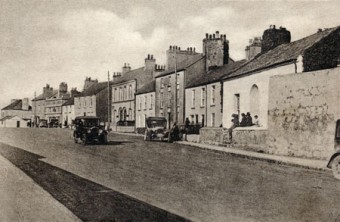
Griffith’s Valuation was done in the mid 1850s in order to survey all land and buildings in the country with a view to putting rates on them. It was a comprehensive project and is a very valuable resource for researchers today. In that survey there are 38 houses listed in the village of Salthill, including those we see in our photograph, the six that were in Beach Avenue (which was known then as Ryan’s Terrace), those that went down to Cremin’s Sea Baths (where Seapoint is today), and a number across the road, roughly where Baily Point is today. There were also some irregular buildings on what is now called Lenaboy Avenue.
Read more ...Joseph Phillips, Connaught Ranger
Thu, Nov 26, 2009
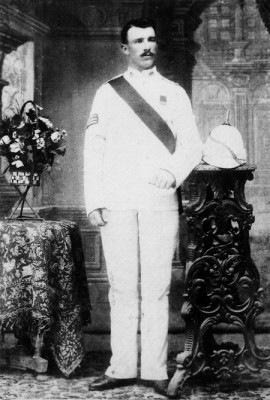
Bernard Phillips, who was born c1835, was a widower who worked with Thomas McDonogh and Co in Merchants Road. He had been married to Mary Bowen from Galway, and they had five children. She unfortunately died, and some time afterwards Bernard was loaned by McDonogh’s to Craig and Gardiner, 41 Dame Street, Dublin, where he worked as a mercantile clerk. While he was there he met and married Teresa Hayes from Dublin. They came back to Galway and Bernard continued working for McDonogh’s.
Read more ...Fitzgibbon Cup winners, 1970
Thu, Nov 19, 2009
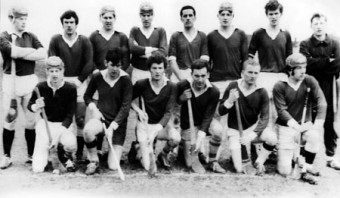
Shortly after the GAA was founded 125 years ago, the universities started putting out hurling and Gaelic football teams and competing against each other. These intervarsity competitions were put on a formal basis with the presentation of the Sigerson Cup for football in 1911, the Fitzgibbon Cup for hurling in 1912, and the Ashbourne Cup for camogie in 1915. Involvement in the GAA in third level institutions was a help to many students in adapting to a new life away from their homes and local clubs. It gave them a common interest with fellow students and helped the process of integration into a more diverse community.
Read more ...The Shambles Barracks, 1910
Thu, Nov 12, 2009
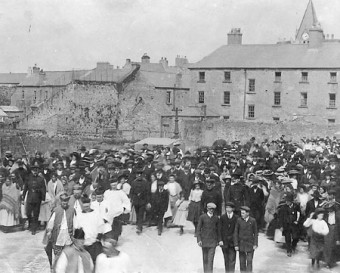
This photograph was taken from the first floor of The Galway Arms at 2.25pm on a summer day in 1910 when these people were processing over O’Brien’s Bridge to the site of Saint Mary’s College for the laying of the foundation stone for that school. The large crowd is being led by a group of priests all wearing birettas, followed by several RIC men. There is an interesting mix of styles on view with some women wearing patterned Galway shawls while others are sporting large fashionable hats. Virtually all of the men are wearing headgear, be they hard hats or soft caps. Notice the tramtracks.
Read more ...Galway supporters at the 1966 final
Thu, Nov 05, 2009
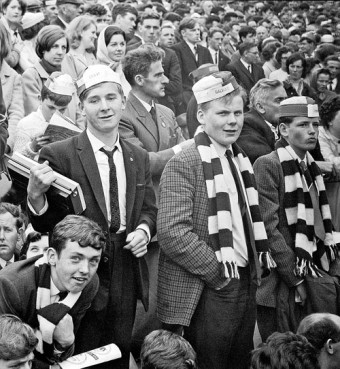
In 1966 Galway were fortunate to get out of Connacht by beating Mayo. To an extent they were also lucky in a hard fought semi-final against Cork. They eventually won what was regarded as the best game of football seen in years, by a score of 1-11 to 1-9. And so they were into their fourth All-Ireland final in a row and going for three wins in a row and the question was, would this team reverse the three losses in a row that Galway suffered at the hands of Kerry 1940, Kerry 1941, and Dublin in 1942? Meath still stood between them and Sam.
Read more ...Scholars from St Brendan's, 1956
Thu, Oct 29, 2009
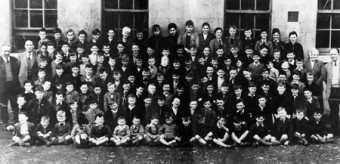
St Brendan's National School opened on St Brendan's Road, Woodquay, in 1916. It was an all-male school which initially catered for boys from Woodquay, Sickeen, and Bohermore. After World War II it began to attract pupils from Shantalla and Newcastle. The school closed down in the 1960s with most of the boys transferring to St Patrick's. The school building was hidden behind a high wall, and it was later demolished. Part of the boundary wall is still visible at the back of the rather dull office block that replaced it.
Read more ...Prospect Hill en fete in the 1960s
Thu, Oct 22, 2009
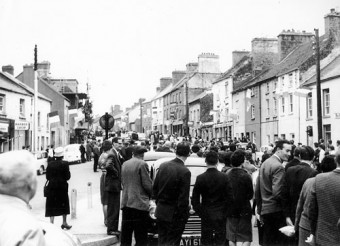
This photograph was taken by Helen Spellman in the early 1960s and shows Prospect Hill all decorated with banners and flags. There appears to be the beginnings of a religious procession at the very top of the hill, which presumably was the reason for all of the colour.
Read more ...Distorted views of the Claddagh in the 19th century
Thu, Oct 15, 2009
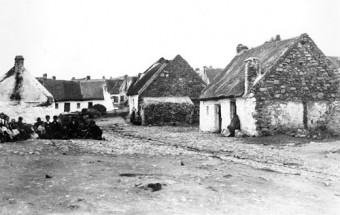
English travellers came to Ireland in great numbers during the 19th century, and Galway formed an important stop on the typical tour. The stopover invariably involved token visits to Lynch's Castle, St Nicholas' Collegiate Church, and Queen's College. A visit to the Claddagh was part of the complement of must-see places, and it eventually became one of the most written about sites in Ireland. Many of these commentators travelled the same routes, stayed in the same country houses or hotels and the resulting texts are frequently similar in both content and perspective. The sameness of description permeates many travel accounts and over the century, new information is rare.
Read more ...Galway vintners
Thu, Oct 08, 2009
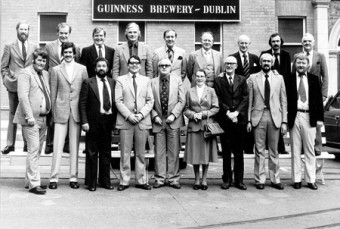
During the reign of Edward VI, when the Puritans controlled Galway, it was provided that “No man should keep an Ale House without being licensed, under penalty of three days imprisonment and a fine of twenty shillings”. It was added: “But because many Ale House keepers in those days were not able to pay that Forfeiture, and it was seldom levied by reasons of poverty, which made people unwilling to prevent the offenders.” Therefore a further punishment was added by statute during the reign of Charles I which not only inflicted the forfeiture of 20 shillings to the use of the poor, to be levied by the constable or church warden, by warrant of a justice before whom the offence was proved, and which distress may be sold three days afterwards; but it provided that if no distress could be taken, the justice should deliver the offender to the constable to be whipped. For the second offence, the offender was to be committed to the House of Correction for a month. A married woman who kept an ale house without licence made her husband liable for punishment.
Read more ...Portrait of the writer as a young boy
Thu, Oct 08, 2009
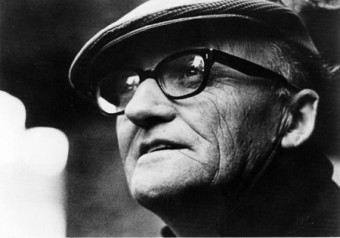
Girls can be cruel. In 1921 Walter Macken was six years old, and in middle babies at the Presentation Convent school. ‘Middle Babies’ had to be a challenge for any six year old boy (who already saw himself as a pilot ‘flying’ through the lanes around St Joseph’s Avenue where he lived). Today the Pres has a thriving national school, in Walter’s time it was predominatly a renowned ‘Girls’ school. It did offer places to boys to a very junior level (you started in infants, then middle babies, and then first class), before the boys moved off to ‘The Bish’ or ‘The Jes’, Mary’s, or Endas.
Read more ...The building of the technical school
Thu, Sep 03, 2009
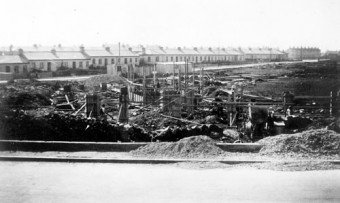
In January 1893 the board of guardians of Galway Poor Law Union decided to establish a technical school, but the plan ran into immediate difficulties. The Local Government Board objected because they had not been consulted, and it took a year for the matter to be sorted out. The moving spirit behind the project was Father PJ Lally, who succeeded in getting money from the Government and secured a premises in Dominick Street (where Áras na nGael is today).
Read more ...