Our Lady's Boys' Club
Thu, Jun 20, 2019
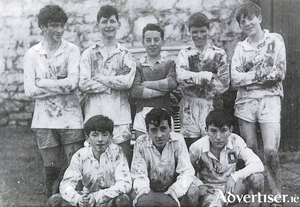
This club is one of Galway’s treasures. It was founded in 1940 by Fr Leonard Shiel SJ at a time when there were no after-school recreational facilities for working class-area boys in the city. The Jesuit Community gave them the use of a clubhouse at the back of the Columban Hall and here the boys were involved in many activities that helped prepare them for life. They were taught loyalty, self-respect, how to help others, and the importance of team spirit. Much of this was through the medium of sport — soccer, swimming, boxing, Irish dancing, table tennis, snooker, etc.
Read more ...St Nicholas’ Collegiate Church and the city
Thu, Jun 13, 2019
Next year the magnificent building of St Nicholas’ Collegiate Church, this venerable edifice in the centre of our city will celebrate
700 years of continuous Christian worship in Galway. The church is the largest medieval parish church in Ireland and its history is a kind of microcosm of the history of Galway. It is thought that it was first built early in the 14th century. There was a legend that a man from the Aran Islands died in the 16th century, aged 220 years who could remember a time when the building did not exist. It sounds like a good story.
Read more ...Tonery’s Pub, sixty years in Bohermore
Thu, Jun 06, 2019
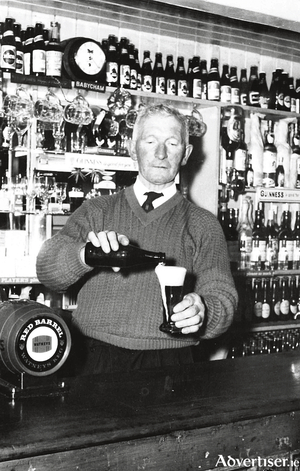
Jim Tonery opened his pub in Bohermore 60 years ago yesterday, on June 5, 1959. It was formerly owned by Johnny and Kate Martyn. The inside walls were whitewashed to keep them clean and also disinfected. Barrels were stored against the back wall and sometimes used as seating with planks on top. One had to be careful when entering as there was a small step down just inside the door, and if you missed it and staggered, you were likely to hear Mrs Martyn say, “Go back to where you came from, you have enough in already”. Johnny Martyn was a blacksmith and he had a forge attached to the pub where he shod horses, made gates, etc.
Read more ...Tonery’s Pub, sixty years in Bohermore
Wed, Jun 05, 2019
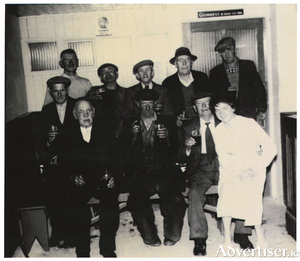
Jim Tonery opened his pub in Bohermore 60 years ago yesterday, on June 5, 1959. It was formerly owned by Johnny and Kate Martyn. The inside walls were whitewashed to keep them clean and also disinfected. Barrels were stored against the back wall and sometimes used as seating with planks on top. One had to be careful when entering as there was a small step down just inside the door, and if you missed it and staggered, you were likely to hear Mrs Martyn say, “Go back to where you came from, you have enough in already”. Johnny Martyn was a blacksmith and he had a forge attached to the pub where he shod horses, made gates, etc.
Read more ...Madden’s garage, 1936
Thu, May 30, 2019
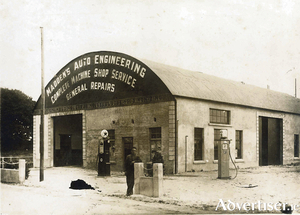
The Madden brothers came originally from near Ballinasloe. They emigrated to the US and when the depression happened, one of them, Jackie, made up his mind to remain in America, but the others decided to return to Galway and set up in business. Two of them, Willy and Charley, developed the nurseries on Taylor’s Hill, Miko opened a garage in Woodquay, and Jimmy built this garage at Nile Lodge with the help of his brother Willy. It was on a terrific location, situated on a junction of the two main roads from the city to Salthill.
Read more ...Madden’s garage, 1936
Wed, May 29, 2019
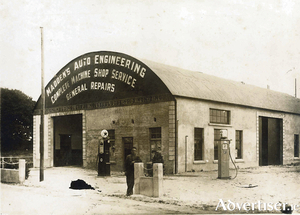
The Madden brothers came originally from near Ballinasloe. They emigrated to the US and when the depression happened, one of them, Jackie, made up his mind to remain in America, but the others decided to return to Galway and set up in business. Two of them, Willy and Charley, developed the nurseries on Taylor’s Hill, Miko opened a garage in Woodquay, and Jimmy built this garage at Nile Lodge with the help of his brother Willy. It was on a terrific location, situated on a junction of the two main roads from the city to Salthill.
Read more ...Medieval Galway
Thu, May 23, 2019
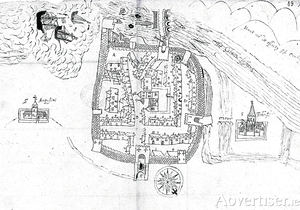
This very stylised plan of Galway was made in 1583 by Barnaby Googe and is the earliest surviving map of the city. It shows the walled town as it stood at the end of the medieval period. Galway was packed with houses: the D-shaped circuit of walls with mural towers and gates was complete; there was only one bridge over the fast flowing river, which was also an important salmon fishery, and it possessed a wharf or landing place for ships. The parish church of St Nicholas and the central market place with its market cross were prominent in the townscape, which was structured around the northeast/southwest axis of Shop Street branching into Main Guard Street and High Street/Quay Street.
Read more ...The ‘blue moonlight’ of Galway 1893
Thu, May 23, 2019
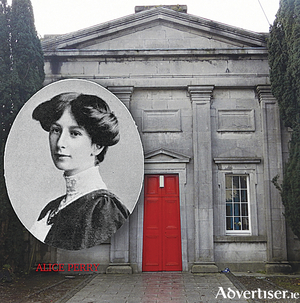
Our Swedish journalist Hugo Vallentin arrived in Galway in the late summer of 1893. He had spent the previous weeks travelling through Dublin, Cork, Killarney and Limerick, assessing people’s reactions to the progress of Gladstone’s Second Home Rule act, which he believed was a question of interest to the whole ‘civilised world’.
Read more ...Medieval Galway
Wed, May 22, 2019
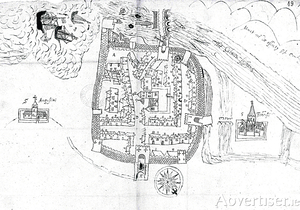
This very stylised plan of Galway was made in 1583 by Barnaby Googe and is the earliest surviving map of the city. It shows the walled town as it stood at the end of the medieval period. Galway was packed with houses: the D-shaped circuit of walls with mural towers and gates was complete; there was only one bridge over the fast flowing river, which was also an important salmon fishery, and it possessed a wharf or landing place for ships. The parish church of St Nicholas and the central market place with its market cross were prominent in the townscape, which was structured around the northeast/southwest axis of Shop Street branching into Main Guard Street and High Street/Quay Street.
Read more ...Druid, forty years in the lane
Thu, May 16, 2019
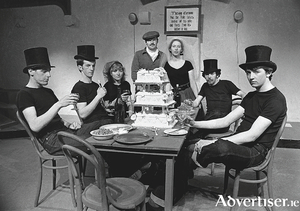
Druid Theatre Company was founded in May 1975 with the initial aim of providing theatre entertainment for tourists in Galway. It opened with three full length plays on successive nights in the Jesuit Hall. The season was a success so they made the very brave decision to operate the company on a full-time basis. Their productions were presented on a fit-up basis, as were a number of lunchtime shows in the Fo’Castle in Dominick Street. They converted this latter venue into a fully equipped pocket theatre seating 47 people. It was a popular venue, well supported, but there were problems with regard to backstage, storage, and office space.
Read more ...Cloran’s Cross
Thu, May 09, 2019
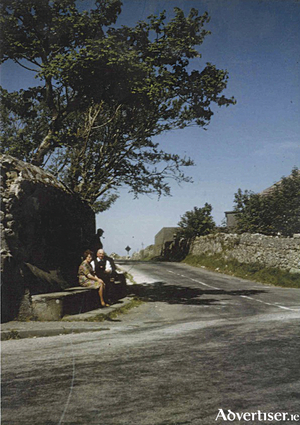
In May, 1846, as part of a Famine relief project, 175 people were employed to build a road linking Dangan to Salthill. Part of that road was known as Bóthar na Mine (the Road of the Indian Meal) because all of the wages were used to buy oatmeal. I have never been able to find out how, when, or why this name was translated into English as Threadneedle Road.
Read more ...The Piscatorial School
Thu, May 02, 2019
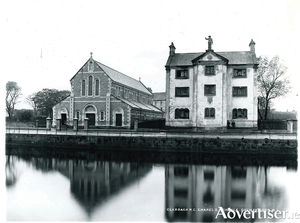
Living conditions were very bad in the Claddagh during the Great Famine. Most people there made their living from the sea but they refused to adapt to new and more effective fishing techniques which would have improved their catches, and so their income was affected and poverty ensued. Most of the fishermen there had put their nets in hock just to keep their families alive. Equally, Claddagh people were opposed to education, as their sons would grow up to be fishermen, they felt no need to send them to school. This form of opposition began to soften and eventually in 1827, a national school opened roughly where the statue of Fr Tom Burke is today. The quality of education there was not great so the Dominicans decided to take things into their own hands and build a school that would develop and improve the practical skills of seamanship and fishing for the boys to make them more self-sufficient. The girls would be taught fishery-related skills such as lace-making
Read more ...The Dockers’ Rugby Team
Thu, Apr 25, 2019
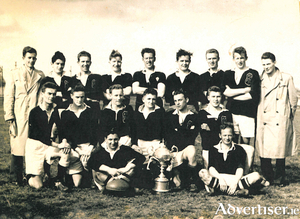
Galway Rovers Rugby Football club first played competitively in 1899. In 1907 they won the Connacht Junior Cup, which had been presented two years previously to the union by Professor Alfred Senior. The club disbanded after that, probably during World War I, but it was revived by a man named John L Sullivan in 1931. At the time, rugby was a very popular sport in Galway, Galwegians RFC had been in existence for a while as had UCG, Corinthians had just been formed, the Bish, St Mary’s, and the Grammar all played rugby, as did Salthill.
Read more ...The Spanish Arch from Long Walk
Thu, Apr 18, 2019
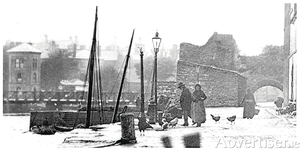
Long Walk was originally built as a wall by the Eyre family in order to construct a mud berth. Among those who lived there around the time this photograph was taken were Tom Gannon, Sarah O’Donnellon, Mrs Hosty, and Pateen Green. There was an entry through a large archway into a courtyard known as Green’s Alley and the five houses there were occupied by the Andersons, McDonaghs, Canavans, Gorhams, and Finnertys. A Mrs McDonagh lived next door in a building known as The Hall and further on lived Mrs Lee, John Folan, Bideen Joyce, Ella McDonagh, Mrs Folan, and Mike Walsh.
Read more ...A pig fair in Eyre Square
Thu, Apr 11, 2019
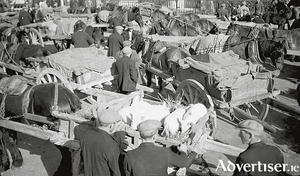
Hely Dutton, in his survey of County Galway in 1824, wrote: “In every considerable town there is a market for fat cattle and sheep once a week. The earliest cattle fairs in Galway were held at Fairhill (hence the name) but in the 19th century, they moved to Eyre Square. It was where the farmer sold his product to other farmers, to butchers and to visiting dealers. It was where town and country met, where the rural people would come to town to sell, then buy whatever necessities they needed before returning home."
Read more ...Salthill Post Office
Thu, Apr 04, 2019
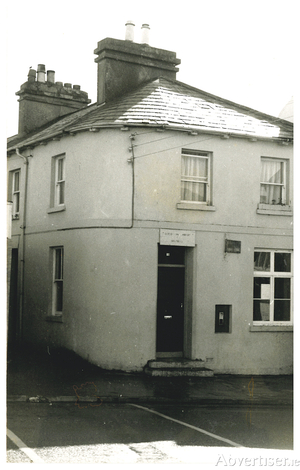
IN 1851, a sub-post office opened in Salthill where the Bal pub is today. In 1859, Salthill was brought within the town postal area. In those early days the post was delivered on foot. The first bicycle postal delivery was in 1901. From 1914 to 1926, Michael O’Flaherty of Dominick Street and Mike Ruane of Henry Street had a horse and van which they used to deliver letter and parcel post to the Salthill area.
Read more ...Salthill Post Office
Wed, Apr 03, 2019
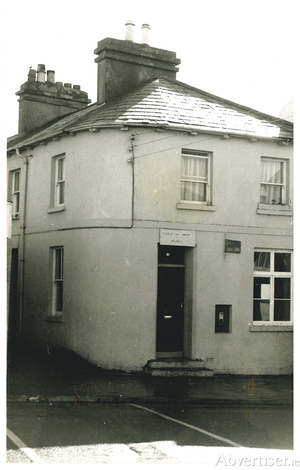
IN 1851, a sub-post office opened in Salthill where the Bal pub is today. In 1859, Salthill was brought within the town postal area. In those early days the post was delivered on foot. The first bicycle postal delivery was in 1901. From 1914 to 1926, Michael O’Flaherty of Dominick Street and Mike Ruane of Henry Street had a horse and van which they used to deliver letter and parcel post to the Salthill area.
Read more ...The Salmon Weir Bridge
Thu, Mar 28, 2019
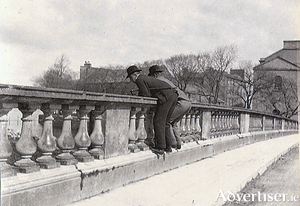
The original purpose of the structure that is the Salmon Weir Bridge was to connect the new County Courthouse with the County Gaol on Nuns Island. Urban folklore has it that they built a tunnel under the river at the time in order to transfer prisoners from one building to the other, but why would they construct a crossing over and under the water at the same time? It does not make sense. The building of the seven span bridge started in 1818 and finished in 1819.
Read more ...The Galway General Omnibus Company
Thu, Mar 21, 2019
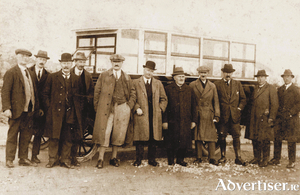
The first regular public transport service in Galway was run by the Galway and Salthill Tramway Company which started business on October 1, 1879, and by 1885 was being used by in excess of 105,000 passengers per year. During World War I, most of the company’s best horses were commandeered by the British Army and there was more and more competition from motorised vehicles, so the tramway ceased trading in April 1918.
Read more ...The County Infirmary
Thu, Mar 14, 2019

A meeting of the corporation held on April 17, 1766, decided that “A committee consisting of the principal gentlemen of the town, be, and are accordingly appointed to inquire and find out a proper place within the county of the town of Galway for erecting a public infirmary or hospital for the reception of the poor, sick and disabled persons.”
Read more ...