Siobhán McKenna
Wed, Nov 15, 2023
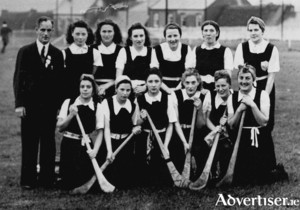
Siobhán Giollamhuire McKenna was born on May 24, 1922, a second daughter to Eoghan McKenna and Gretta O’Reilly, Nancy being her older sister. She was educated in Belfast, in Taylor’s Hill Convent and then after a year out sick with glandular fever, as a boarder in St Louis Convent, Monaghan.
Read more ...Galway’s triumph in the 1923 final
Thu, Nov 09, 2023
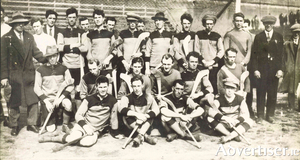
This game was not actually played until September 1924 when Galway faced Limerick in a ‘dour hour’s hurling’. “Physical strength, fitness and courage were the dominating factors. The play was strenuous if fitful and an exciting period followed the interval when Limerick made determined efforts to wipe off the arrears. Galway finished with great dash and were clearly superior on the day’s form.” These were the words of PD Mehigan who reported on the game for the Irish Times.
Read more ...Galway postboxes
Thu, Nov 02, 2023
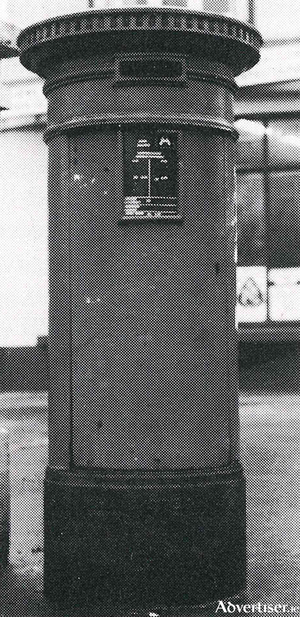
The regular use of the words “post” and “Litir” in 15th century Irish manuscripts suggests that by that time, a postal system was already in existence here. In 1657, a Bill was passed ‘for settling the postage of England, Scotland and Ireland’ which set up a Government monopoly of the service. The Galway Post Office had been established in 1653, and the network of Post Offices throughout the county gradually grew.
Read more ...Remembering Maurice Semple
Thu, Oct 26, 2023
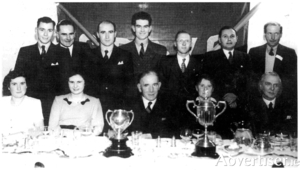
Maurice Semple was born in 1917, a member of a family that had continuous connection with the ‘Citie of the Tribes’ for over 400 years, one of three children of Frank Semple and Elizabeth ffrench. His father worked in a clerical capacity in the courthouse, his mother was one of the ffrenchs from Claregalway. Both his brother ffrench Semple and his sister Mary predeceased him.
Read more ...The changing face of Kingshill
Thu, Oct 19, 2023
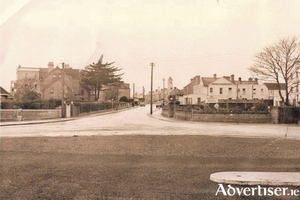
Our first photograph today (courtesy of the National Library) is a bird’s eye view that was taken in 1953 and shows the Warwick Hotel at the top of the picture. Next to it on the right was the entrance to Lenaboy Park, and beyond that you can see part of Queeney’s shop. Next door was Doorley’s private house and then Mrs Turke’s B&B called Osterley Lodge. Opposite, on the far side of the road was Billy Binn’s house and on the corner, as you can see, was a field with a lot of trees, much used as a playground by local children. This whole area was very prone to flooding and was occasionally rendered impassable, as was the case with Hurricane Debbie.
Read more ...Traffic changes in Galway
Thu, Oct 12, 2023
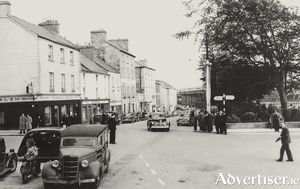
When the city was being constructed in medieval times, the streets and even the lanes must have appeared wide and spacious. The only kind of traffic they would have experienced then would have been pedestrian, horse or donkey and cart and maybe the odd wheelbarrow. We have two images for you today of the east side of Eyre Square the first (courtesy the National Library) dates from c1890 and shows that type of traffic; The second (courtesy Galway County Library) shows the same area with motorised traffic. Since the latter was taken, the population has grown by 6 or 7 times, and of course, the traffic volumes have increased accordingly. So the Corporation had to make occasional changes to the bye-laws in relation to traffic.
Read more ...Galway Simon — still changing lives after campaigning beginning
Thu, Oct 05, 2023
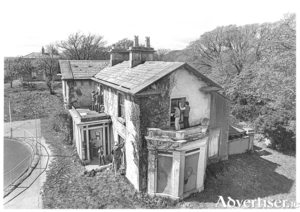
In October 1979, two psychology students, Margaret Brehony and Kathy O’Grady teamed up with a philosophy student, Conall Mac Riocard and formed a group of volunteers. They started a twice weekly soup run to people who were sleeping rough in Galway. They made the soup and sandwiches at home and then they would do the run.
Read more ...The scholars of '73
Thu, Sep 28, 2023
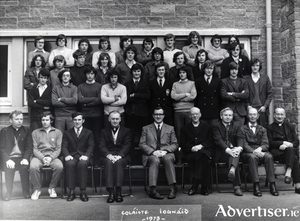
What memories do you have of your schooldays? Here are some reminiscences of a few old ‘Jes-mugs’.
Read more ...The Fishmarket
Thu, Sep 21, 2023
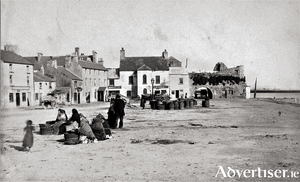
The village of Claddagh was a unique collection of thatched cottages arranged in a very random fashion, a place apart, occupied by a few thousand souls. They had their own customs, spoke mainly in Irish, intermarried, elected their own king and had a code of laws unique to the village. Virtually the entire male population was involved in fishing, but when they landed their catch, the women took over and they were the ones who went out and sold the product.
Read more ...Arms of the city
Thu, Sep 14, 2023
A coat of arms is described as a heraldic visual design on an escutcheon surcoat or tabard. The coat of arms on the escutcheon forms the central element of the full heraldic achievement which in its whole consists of a shield, supporters, a crest and a motto. A coat of arms is traditionally unique to the armiger.
Since its foundation in the early 13th century, the town of Galway has used at least five different coats of arms. The first three of these did not, as far as is known, belong to the town proper but were used by townspeople for official purposes in the absence of specific town arms.
Read more ...Saint Patrick’s Church
Thu, Sep 07, 2023
This photograph of St Patrick’s Church and part of Forster Street was taken from the Galway/Clifden Railway Line overlooking James Mahon’s Field where the circuses used to be long ago. It was taken c1920.
Read more ...Lydon’s restaurant
Thu, Aug 31, 2023
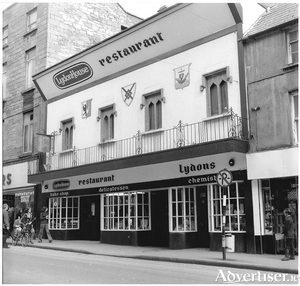
In October 1935, the local papers reported that Mr Thomas Lydon was about to open a super restaurant, installed with the latest conveniences, over his well-known confectionery shop on Shop Street. “A masterpiece of Modernity. Its equipment is the most up-to-date procurable including a Major ‘Esse’ Cooker, Electric Magrini Toaster, Scott Electric Hot Plate, Cold Storage room and a Frigidaire Ice Cream cabinet, The entrance to the restaurant is through the handsome shop premises which have also been modernized and where the aromas of freshly made bread buns and cakes was mouth-watering. The work of the restaurant, which could seat 200 people, is carried on by a well-trained staff of about thirty.”
Read more ...St Patrick’s National School
Thu, Aug 24, 2023
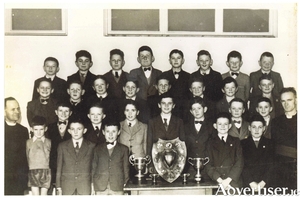
On January 15, 1827 two Patrician Brothers, Paul O’Connor and James Walsh, took up residence in Lombard Street and set up the Monastery School. The attendance on that first day was 300 boys, many of whom had little interest in learning because they were poor and hungry. So the Brothers set up The Poor Boy’s Breakfast Institute in May 1830. It continued seven days a week, 365 days a year for many years after the founders' time. The breakfast consisted of porridge with molasses or treacle, and during the Famine, they fed 1,000 boys every day. The ‘Old Mon’ became a vital cog in education in Galway.
Read more ...Lynch’s Castle
Thu, Aug 17, 2023
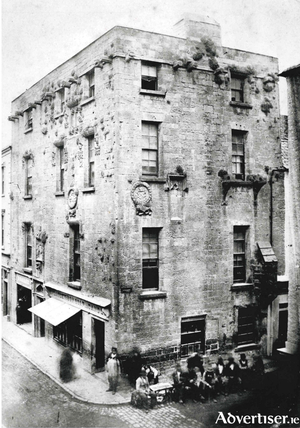
Lynch’s Castle is one of the finest surviving medieval townhouses, one of the best known examples of pre-Renaissance architecture in Ireland. It is essentially a two-period structure, the original 16th century castle was square in plan and was limited to the space now occupied on the ground floor by the vestibule of the bank. That portion to the west on Shop Street was added c1808. The extension is evident in the masonry of the exterior of the building, and the window hood-moulds of this section are very different in the character of their detail and carving from the original work. It is likely that the whole interior was remodelled and the storeys altered at this time, the window hood-moulds, the panels, the gargoyles, etc, being moved to their present positions.
Read more ...Frank McDonagh & Co
Thu, Aug 10, 2023
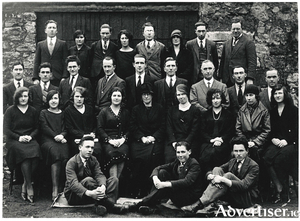
Frank McDonagh and Company were wholesale and retail drapers and outfitters that opened in Williamsgate Street in 1883. In early advertisements, they described themselves as “Successors to M. Hennessy, the house for original Claddagh cloaks as supplied to the Royal family”.
Read more ...Lifesaving in Galway
Thu, Aug 03, 2023
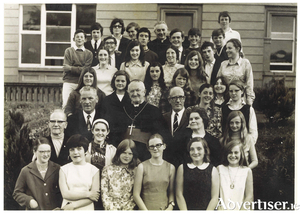
Organised water safety in Ireland really began in Milltown Malbay, Co Clare in the 1930s when a lady drowned there. This galvanised the local community into forming a Water Safety Association to help swimmers who got into trouble. The idea spread through Co Clare and eventually to the whole country. The national water safety section, set up by the government, was run by the Red Cross.
Read more ...St Augustine’s Fort/Forthill
Thu, Jul 27, 2023
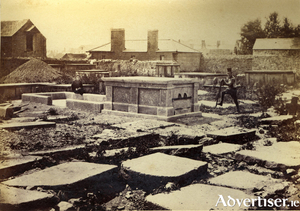
The site of the Augustinian House when the order first came to Galway in 1508 was on the hill we know as Forthill today. Margaret Athy, the wife of the Mayor Stephen Lynch, invited them and she built a church and steeple there too. Her husband was away in Spain and got a shock when he returned to see the finished new building on the hill. The friars moved into a house within the walled city but their church was still between the city and the bay.
Read more ...The Hat Factory
Thu, Jul 20, 2023
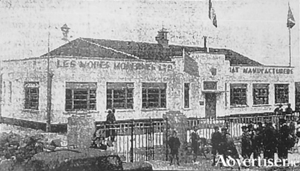
In the 1930s, Ireland instructed all of its consul officials in Europe not to issue visas to Jewish refugees, but the country was also in a state of economic stagnation at the time and Seán Lemass realised that new industries would help the country. An Irish Jewish businessman, Marcus Witztum, offered to help him and went to Paris, met Henri Orbach there who owned a small hat factory and suggested he open a business in Ireland, a safer place for people of the Jewish persuasion than continental Europe. Orbach agreed.
Read more ...In memory of Criostóir
Thu, Jul 13, 2023
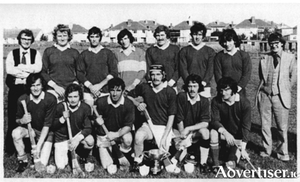
A ballad is a form of verse, a poem or a song that tells a story. It can be considered either poetic or musical and is written in short stanzas with a rhyming system abcb. These forms of folk songs were often anonymous retellings of local legends, stories of particular events or characters.
Read more ...Donal Mac Amhlaigh
Thu, Jul 06, 2023
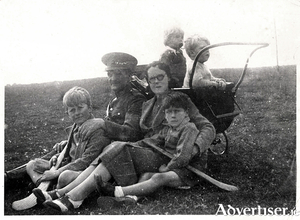
Donal Mac Amhlaigh was born on Cappagh Road in Barna on December 10, 1926. His father James was a native of Kinvara who fought with the East Clare Brigade of the IRA in the War of Independence and who later joined the Irish Army. His mother was an Irish speaker, Mary Condon from Cappagh. They had three sons and a daughter in family. Pádraic Ó Conaire was a regular visitor to their house.
Read more ...