In his wonderful book Down by the Claddagh, Peadar O’Dowd wrote: “The Old Claddagh, with its white-washed walls, golden thatch and the colourful clothing of its inhabitants, was a readymade canvas for countless artists and book illustrators. Walter Osborne, Augustus John, Harry Kernoff and Charles Lamb were some of the famous names who came to pay homage to the living landscape of the old Claddagh. In more recent times, artists such as Kenneth Webb, John Mulhern and Derek Biddulph have sought to capture, in their own individual styles, the magic that was the Claddagh.”
That was the romantic view of the Claddagh, except it was not always romantic. There were harsh realities to living there, as our first photograph (taken c1930 ) shows … an elderly lady having to wash her clothes in a tiny outdoor space in less-than-ideal conditions at the back of her cottage. You can see her primitive clothes-line in the foreground of the photograph. The whitewashed cottages of the village were kept very clean, inside and out, but it was hard work as there were no sanitary facilities, no running water. Women (almost always women ) were kept busy carrying water from the taps in the lanes.
If a woman wanted to whitewash her cottage, she got the water from the tap, made up the mix and used her broom to spray the wall, then she would go pat, pat, pat with the broom as if to make the liquid take and stick to the wall.
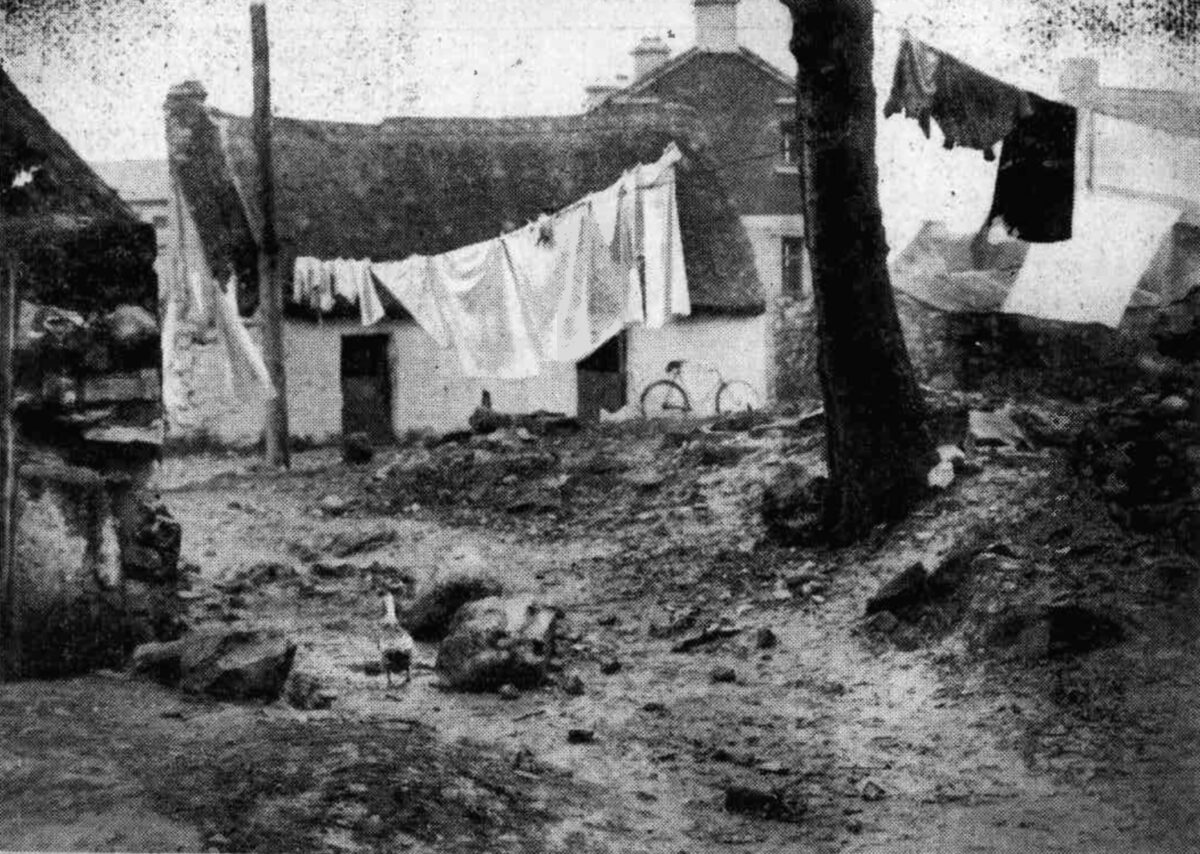
The washing was weather dependent. They washed in the open air when it was dry, and they always hung their clothes out to dry when the weather was clement, as you can see from our second photograph, which also dates from the 1930s – you can barely make out the new Claddagh houses in the background. As you can see, they had to be inventive when it came to putting up clotheslines too.
In 1927, 255 Claddagh houses were surveyed, 51 were classed as ‘poor’, 69 as ‘bad’ and 106 as ‘very bad’. The village was declared ‘’an unhealthy area’ that year, so it was inevitable (in spite of a great many objections ) that it would be completely rebuilt. Many had hoped that they could retain and develop the old thatch cottages, but it was obvious that the best of the thatched homes could not compare with the new series of houses built from 1925 onwards for British ex-servicemen at Beattystown and Frenchville, just west of the Claddagh. The debate raged on but the Old Claddagh began to disappear as construction went on. It was not necessarily a popular decision, but from a health point of view, there could be no argument.
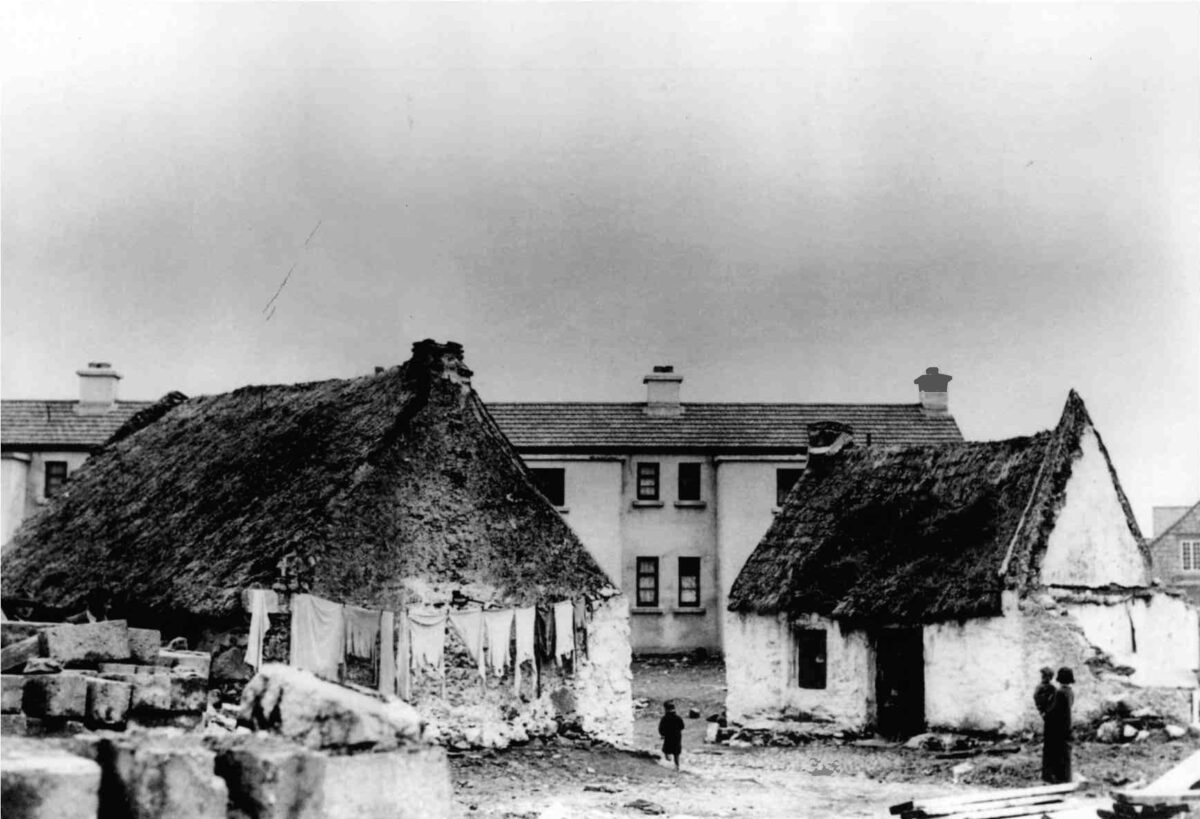
The new houses we see in the background in our third photograph are the backs of what is Claddagh Avenue today. There are no gardens yet, but curtains in the windows would seem to indicate they were already occupied. You can see part of the Claddagh Hall in the background on the far right.