“This fine building, which is superior to most Provincial seats of justice in Ireland, stands at Newtownsmith on the site of the ancient and venerable abbey of the Franciscans, which by the Charter of Charles II ‘is to be and remains part of the County of Galway forever’. It was commenced in 1812 and on the 1st of April 1815, was opened for the reception of the then going justice of assize……
“Besides the two spacious and well-appointed courts for transacting the civil and criminal business, with grand and petty-jury rooms adjoining, there are several commodious offices and apartments for the High-Sheriff, Treasurer, Clerk of the Peace and other law officers…… The lofty portico, entrance and extensive hall of this fine structure will immediately attract attention. It is altogether an edifice highly creditable in the County and considerably ornamental to the town.”
So wrote James Hardiman in his History of Galway published just five years after this building opened. It effectively replaced the Tholsel, which had burned down, as the main courthouse. The Tholsel, which also contained a prison, was in Shop Street and backed onto the graveyard of St Nicholas’ Church.
The authorities were very proud of their new courthouse, which was directly across the river from the new gaol. The obvious thing to do was to link the two, and so the Salmon Weir Bridge was built and opened in 1815.
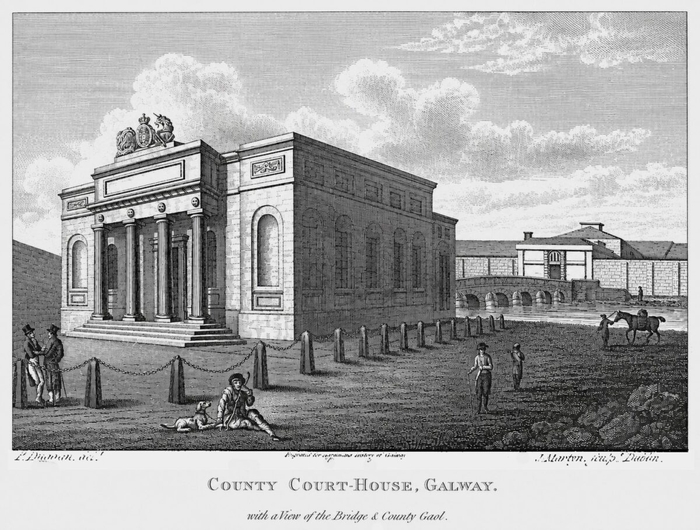
In 1890, the Courthouse was renovated and modernised for the 20th century, complete with a new roof. After the Easter Rising, a lot of nationalists were before the courts, and they were followed by members of the IRA after the War of Independence. When the Courthouse was built, a large stone carving of the Royal Coat of Arms with the lion and the unicorn on either side of the great shield was placed over the impressive portico. After the Treaty was signed, this coat of arms was removed to the grounds of UCG where it can still be seen. The pillars and chains that surrounded the building, (seen in our drawing by P Duggan which appeared in Hardiman’s History, 1820 ), have also been removed.
The Galway City Courthouse (known as the Town Hall today ) was built 10 years after the County Courthouse on the site opposite. It was designed by a local architect with a classical façade to counterbalance the building on the other side of the square. It also had a large stone carving of the Royal Coat of arms, a little smaller than its counterpart. It too was removed after the War of Independence and is now stored in Galway City Museum. After a number of years, it was decided that there was no need for two courthouses and so all of the court business has been based in the county one while the city one was closed and later converted into a variety theatre which later became a cinema and eventually closed down. It lay derelict for a few years until Michael D Higgins, as Minister for the Arts, stepped in and provided the finance to renovate and convert it into the wonderful theatre it is today.
When Judge Durcan opened a sitting of the Circuit Court in the summer of 1951, he was presented with white gloves by the County Registrar to commemorate a court sitting for which no case of crime was listed. A similar ceremony had taken place a few years before that just before the death of Judge Wyse Power. As far as can be ascertained, these are the only two instances of white gloves being presented in Galway since the country took over its own court affairs. The ceremony does not constitute so much a tribute to the judge as to the people and gardaí of the county where the court is held as it denotes a crime-free county.
Our illustrations show the drawing of the Courthouse c1820 and a photograph of the scene as the magistrates arrive for a court c1900.