
In Séamus King’s remarkable book The History of Hurling, there is a reference to hurling being played as far back as 1,200 BC in Tara, Co Meath. The earliest written references to the sport in the Brehon Laws date from the fifth century. It was played in ancient times by teams representing villages, involving hundreds of players, and the match might last several hours, even days.
Five hundred years ago, in 1627, it was decreed in one of the Galway Statutes that, “At no time to use ne occupy ye hurling of ye little balle with the hookie sticks or staves, nor use no hand balle to play without the walls, but only the great foot balle”. The English authorities were trying to ban the game of hurling, the most Irish of games. They might as well have been trying to hold back the tide.
It is an ancient field game, Gaelic in origin and has common Gaelic roots with Shinty in Scotland, Bando in England and Wales and Cammog in the Isle of Man. It is the fastest game in the world on grass and one of the most skilful, requiring agility, bravery, fitness, strength of wrists, hand-eye coordination and teamwork. It generates communal spirit, a deep-seated territorial loyalty where amateur players compete for the ‘credit of the little village’. When the GAA was founded in 1884, the game was organised around a set of common rules. The GAA has been responsible for developing loyalty to ‘the jersey ’, whether it be playing for or supporting one’s county or ‘the pride of the parish’.
Many clubs and schools now start the boys’ and girls’ training at a young age, developing their skills. Anyone who has ever lifted a hurl will remember the thrill of soloing with the ball for the first time — you were faster than the wind; the thrill of your first ground stroke to fly up in the air, the sheer joy of the first time you put it over the bar.
Just as in ancient times, the game today is played by teams representing villages. Today they are called clubs, and they are the great strength of the GAA. The club structure has always guaranteed intense competition and long may it continue.
One of the real strengths of Galway hurling has always been its highly competitive club structure. One of the oldest clubs in the county must be Turloughmore which is 140 years this year. There were a number of teams in the parish but they all came together under the banner of Turloughmore. They won their first County Senior title in 1956.
They have decided to mark this special anniversary by compiling a history of the first century of the club, 1886 – 1986, and they are looking for help, so if you have any memorabilia relating to the club, could you please contact Seán Walsh at 087 266 1502 or at [email protected]. He is looking for old press clippings, photographs of teams, players, medals, stories, legends, anything relating to the club. If you have images of teams, could you please add any names you know. Everything he receives will be copied and returned.
So, we have two teams for you today, the first (above ) a wonderful image of the 1892 William O’Brien Turloughmore team. We have no names for the players but maybe they will be included when the history is written.
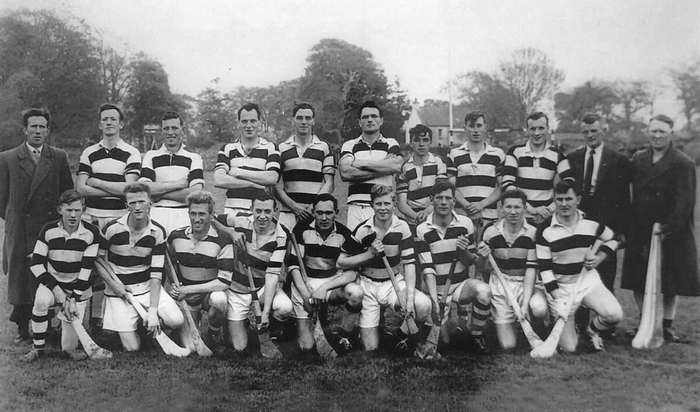
The second image is of the 1960 Turloughmore senior team. They are, back row, L to R: Larry Doyle, Jackie Gill, Paddy Caulfield, Jimmy Burke, Johnny Burke. Packie Burke, Mikey Keary, Paddy Delaney, Noel Garrett, Mattie Healy and Peter Costelloe.
In front are: Bobby Madden, Frank Forde, Paddy Fahy, PJ Qualter, Michael Cullinane, Paddy Langan, Alfie Glavin, Seamus Fallon and Frank Fahy.
Finally, our sincere congratulations to Mícheál O’Donoghue and his band of warriors for bringing Galway to the ultimate game of the season. So, get out your flags and banners and support them all the way. Gaillimh abú!
