The Royal Irish Constabulary (RIC ) was founded in 1822. For organisational purposes, Galway was divided into two districts, East and West, commanded by two inspectors who reported to the RIC Commissioner in Dublin Castle. From its foundation, the force faced particular challenges in Galway due to the persistence of land hunger among the poor, who organised themselves into secret societies and resorted to cattle driving and violent disputes over land. As a result, County Galway had the highest concentration of police in the entire country.
The actions of the Black and Tans seriously damaged the reputation of the RIC, and they were boycotted by the public. Many disputes were settled by Republican courts. When the Free State was established, initially, policing was the responsibility of the army. The first detachment of the Civic Guard was transferred from Dublin to Galway in September 1922, and their commander stated, “We are an entirely civil force and do not carry any firearms. Our only weapon is a truncheon and our mission is to carry out the civil law irrespective of party politics. We shall consult with the local parish and district judges as to how this may best be done in this area.”
The West Division was headquartered in Galway with a chief superintendent in charge of four districts: Galway, Tuam, Clifden and Oughterard. The change from RIC to Garda Síochána took a little time for the public to absorb, as can be seen by our first illustration, a 1922 cartoon from Dublin Opinion.
The Civic Guard first came to Galway on September 25, 1922, a party of 25 who were stationed in the County Club because the Eglinton Street barracks had been burnt down by the Irregulars during the Civil War. This new police force was welcomed by the public, and they immediately set about enforcing the licensing laws and maintaining public order in the city. The laws were enforced fairly, including those governing alcohol. Courts began functioning regularly in area controlled by the Gardaí. The Guards themselves, through their tact and courtesy gained the respect of many people across the city.
On August 8, 1923, the Civic Guard was renamed An Garda Síochána. They were actively recruiting and by 1926, there were 63 Garda stations throughout the city and county. Each guard was issued with dry battery lamps, a whistle, a truncheon and a pair of cumbersome handcuffs. The Garda Síochána Establishment Scheme had provided for a reduction in the force and as a result the County Galway force lost over 500 members and so a major recruitment campaign was started as can be seen from our main illustration.
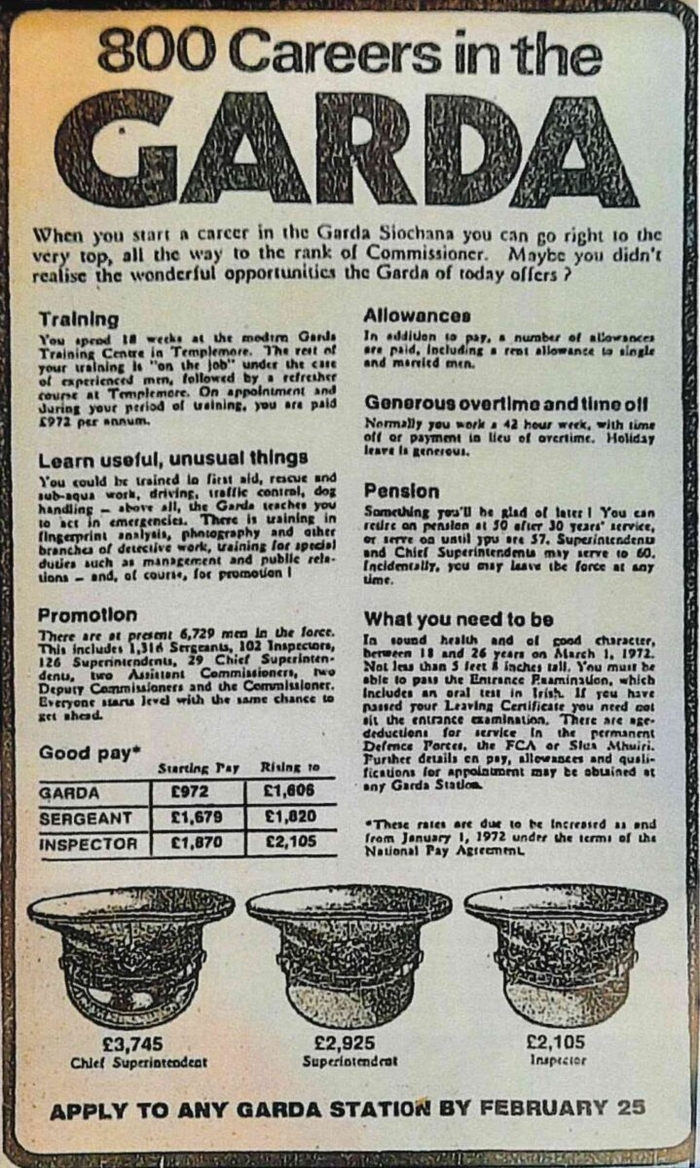
All of the above is taken from a new book entitled Duty, Aspects of the History of An Gárda Síochána in Galway, a collaborative project between An Gárda Síochána and the Heritage Office of the County Council. It is bilingual, profusely illustrated and brings together personal accounts, historical records and community perspectives. Superintendent Damien Curley has done a superb job in compiling this book, which, unfortunately is not on general sale. There may still be some copies available at Garda Headquarters in Murrough, and you can also download it. It is full of information and well worth reading as it acknowledges the outstanding service and dedication of Galway Gardaí.