Galway Rovers Rugby Football Club first played competitively in 1899. In 1907, they won the Connacht Junior Cup. They disbanded after that, probably due to World War I, but the club was revived in 1931 by a man named John L Sullivan. In the early days, they were given a clubhouse in the old Galway Steamship Company. Initially they wore green jerseys, but later they changed to colour to black and were often referred to as “The Blacks”. The first team to represent the club was made up entirely of men who worked on the docks, so inevitably, they became known as “The Dockers”.
They soon established a reputation as a tough but fair side, at their best when rucking or mauling rather than doing fancy footwork. One of their stalwarts once eloquently described them as follows: “On the whole, we were more of a forwards team than a backs team.” They moved their headquarters to the Claddagh Hall and they had their own pitch in the swamp. They disbanded again during the war years but restarted immediately afterwards and became one of the best junior clubs in the country, appearing in six Junior Cup finals in the fifties and winning three. They disbanded for good in 1961.
Uniquely, they had their own band, The Dockers' Band. It was a fife and drum band that used to play at all the Dockers' rugby games. They provided a lot of energy and colour at these matches and they performed at other functions as well and used to parade on the streets occasionally. They always featured in a big way at fellow dockers' funerals and were known to march from the Pro-Cathedral to Rahoon Cemetery while playing all the way. They broke up in the sixties, probably at the same time as the rugby club, but Martin Hoare managed to revive them for a number of years. This new group were kitted out in a uniform with snazzy blazers.
Our rugby photograph is of the Dockers team that won their seventh and last Connacht Junior Cup in 1957 by beating Ballina 17-3 in the final. They are, back row, left to right: Joe Ryan, Brendan Dowling, Tim O’Halloran, Frank Hayes, Brod Conneely, Noel Corcoran, Dom Maloney, Eamonn McGuire and Paddy Norman. Kneeling are Buddy Ward, Dermot McSweeney, Peter Folan, Tommy McCarthy, Des Crowley, and Joe McGuire. Seated are Donie Kelleher and Paddy Monahan. Eamonn McGuire lined out as wing-forward that day as he would, memorably, a few years later line out many times in that position for Ireland. Dermot McSweeney, a well-known hurler with Liam Mellows, played full back under the pseudonym of D Flaherty.
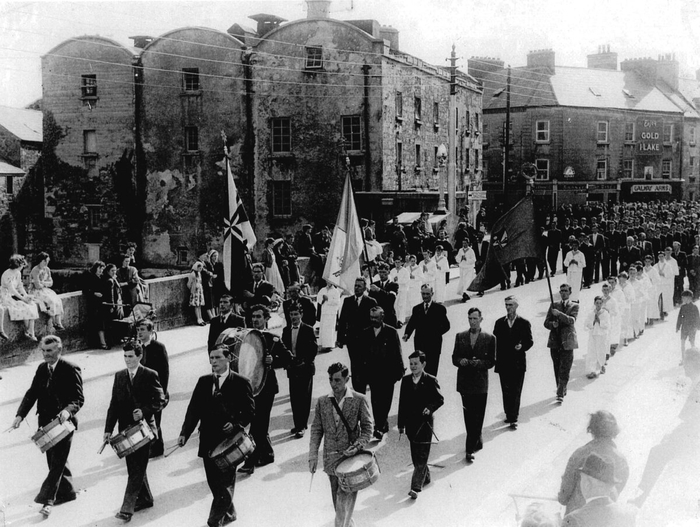
Our photograph of the band crossing O’Brien’s Bridge in a Corpus Christi procession was taken in the late fifties. We know three of those in the front row are John McDonagh, ‘Banners’ Murphy and Dominic Murray. A man named Murray played the big drum. Stephen McDonagh is seen on the right of the second row, and somewhere at the back is Seamus McDonagh.
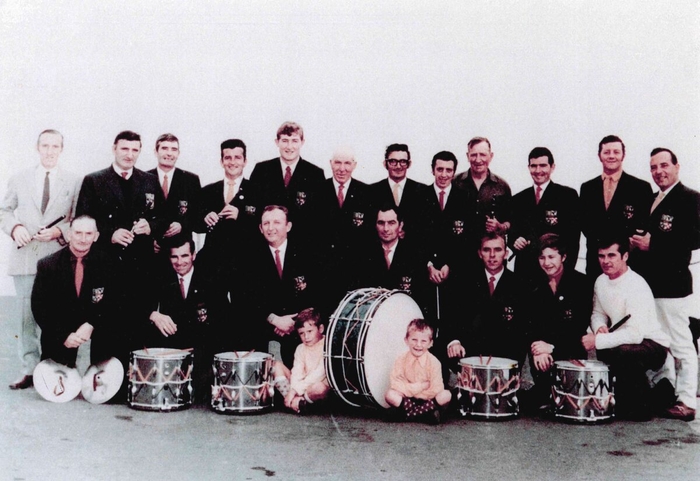
Our photograph of the ‘revived’ band in their blazers shows, from the left, back row: Two brothers from Quay Street; Mike McDonagh; Paddy McDonagh; Leo Connell; Martin Hoare; Steve Cassidy; --------- from Shantalla; Stephen McDonagh; John McDonagh; Wally Joyce; and Martin McDonagh. In front are Ted Blakeney, Mike McDonagh, Donal Flaherty, Dominic Murray, -- Spellman, Martin Hynes and Willy Blakeney.
Our thanks to Martin Hynes for his help in compiling this piece.