
The correct name of this area is Blake’s Hill which comprises approximately 30 acres. An early Admiralty chart refers to it as Mount Blake. It is a drumlin, as is Carragh Hill, a continuation of it. Gentian Hill was a much smaller area further north but the whole area is now referred to as Gentian Hill. There is a ringfort on top of the hill which became evident from aerial photographs.
An extract from O’Donovan’s Letters, c1838, described the area as follows: “Here in Blake’s Hill, over the sea, whither the young men of Galway were wont to come on horseback on the third day of their May game, and there to dine between the hill and the castle of Barna. Sir Morag O’Flaherty of Aughanure defeated an army out of Clanricarde on the 22nd of June, 1564 on the strand at Traybane, Cnoc an Bhlácaigh”.
In 1893, a nine-hole golf course was built on the hill. The land belonged to a Mr Gallagher, who initially would not allow anyone access to play there unless they paid an exorbitant fee. However, a series of complaining letters to local papers generated enough publicity to encourage him to lease the land to the newly formed Golf Club @ £15 per annum. The course had very fine views, the distance around was about a mile, the hazards consisted of boulders and gorse, there was a nice pavilion on the grounds, the greens were smooth, undulating and of infinite variety, the turf crisp and pleasant, drying quickly after rain. All that was required to make it a very good course was plenty of play.
One of those who joined the club was Sebastian Nolan, who owned Seamount House, a terrible bore who found it hard to get anyone to play with him, so he bought the entire hill. In 1903, he began to disapprove of the interpretation of the rules by the committee and finally turned the members off his land, put bailiffs in charge and refused to allow anyone to play, except as his guests. The club members got together and established a new course on the Barna Road and that signalled the end of the Gentian Hill golf course.
Our first photograph, dated c1950, shows an empty Gentian Hill apart from a number of tents and caravans parked there. To the left, in the distance, you can see the sheltered inlet known as Sáilín where local fishermen used to moor their boats. It is flanked on the right by Oileán na Feamainne, or Seaweed Point, known locally as Redington’s Hill, a commonage for Knocknacarra people, some of whom had seaweed rights there. The low-lying parts of it were covered by high tides.
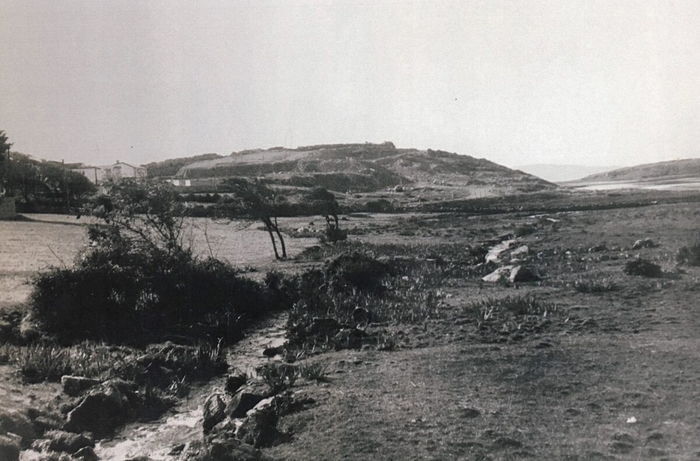
Our second image is of Gentian Hill as seen from the Barna Road. In the foreground, you can see the Clybaun Stream. In 1971, some drainage works at Knocknacarra Cross near the stream here revealed some wooden timbers, which proved to be part of a water-driven mill known as a horizontal mill. The National Museum carbon-dated a sample of the timbers and they dated to approximately 600 AD. While nothing was visible over ground, these mill timbers suggest the existence of a settlement, the earliest evidence (dating to some 150 years after St Patrick ) of a settlement in the area. The remains are now preserved in University of Galway.
Rusheen Bay, seen to the right of this photograph, is the only County Council Bird Sanctuary in Ireland. It has a bird population of some 1,500 birds in the winter months. There are many winter migrants seen here, particularly the duck family.
The placename Knocknacarra derives from the Irish “Cnoc na Cara” or ‘The Hill of the Stone Crossing’. ‘Cara’ was a common name along the west coast where there are numerous small islands which are accessible at low tide by means of stepping stones, or rough causeway, for which the Irish word is ‘Cara’. At Knocnacarra Cross, there was a narrow channel through which the Clybaun Stream flowed into the salt lake. At one point, there were large stepping stones there which allowed people to cross, hence the name. Another school of thought thinks it derived from ‘Cnoc na Cathrach’, the Hill of the City, or maybe the Hill to the City.
Our thanks to Mrs Valerie Nestor for her help with the above.
