
By 1848, construction of the railway line west from Dublin had reached Mullingar and the following year, the Chancellor of the Exchequer agreed to advance a loan of £500,000 towards extending the line to Galway. The board of the Midland and Great Western Railway entered into a contract with William Dargan to construct the entire length of line from Mullingar to Galway. Dargan’s success in building the Howth to Dublin railway had earned him a bonus of £300 and this he used to set himself up a a railway contractor.
He had as many as 900 men on his payroll. He quickly started work on the bridge over the Shannon at Athlone and the one over the Suck in Ballinasloe. The viaduct at Lough Athalia comprised five spans, two of 60 feet and three of 20 feet. Following agitation from the business and shipping interests in Galway, it was agreed to include an opening span in the viaduct to facilitate entry and exit of tall-masted vessels. Galway folklore tells us that as far as is known, the bridge was opened on one occasion, and that was for the Inspector of Railways prior to the opening of the line. Granite from Merlin Park was used in the construction.
The Galway Vindicator of May 28, 1851 reported "Forthill has at last been cut through and wagons are running across Lough Athalia Bridge with filling stuff for the space beyond. The terminus will soon be ready to receive the iron roof which is landed on our wharf."
The line was duly completed on July 20, 1851 and was inspected eight days later by the railway inspectorate. Dargan was five months ahead of schedule. The official opening was on August 1 and the directors, having due regard to the funds of the company and the depressed state of trade in the country, did not celebrate the event by any public entertainment.
The first train journey was described as follows: "We arrived in Galway at the very second of time announced in the bill, and this in spite of unavoidable delays at stations in consequence of the crowds. Galway looks busy and clean, the works on the river Corrib approach completion, the Railway Hotel is being built and certainly that hotel will be a great blessing to the town if we are to judge by the rest of the inns and by the wretched entertainment we got in one of the Galway hotels today."
The last section of 76 miles from Mullingar to Galway was the longest section of railway to be opened in Ireland on any single day. In 1859 a plan was mooted to run a train service from Lough Athalia Bridge via the docks and Claddagh to Fairhill but this was dropped as was a proposal to connect a spur from Galway to the Salthill Tramways line with the MGWR station. In 1858, the line to Athenry opened.
Kevin Brophy, in his wonderful autobiography Walking the Line described the last section of the track from Renmore Barracks into town as follows: "The Line was separated from the railway by four strands of smooth wire linking a string of wooden posts. Both Line and railway ran along the top of a high causeway. When you were used to walking the Line you marked it off in your mind in sections. The first piece was all downhill, the small chapel on your right, then the stretch of plots where some soldiers grew potatoes and onions and cabbages. Sometimes, if you were hungry, and the place was deserted, you’d climb through the wires into the plots and pick a handful of young scallions that grew in the summertime. If you were crossing the bridge at the same time as a train was pulling in or out, you could feel the bridge tremble and groan under the clanking mass of iron, and sometimes the engine would hiss loudly and clouds of smoke would billow around you."
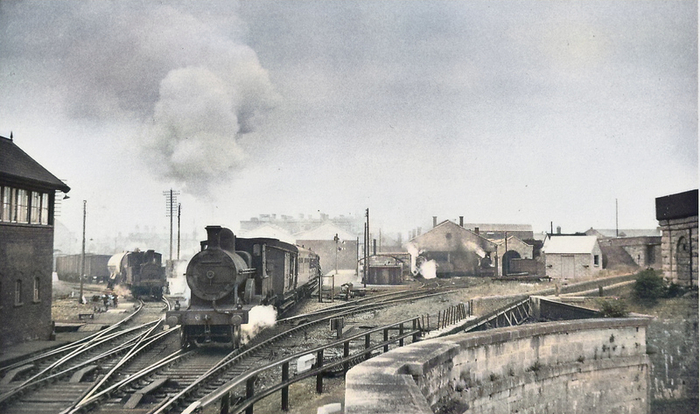
Our first photograph shows locomotive No 554, named Fly, which was built in 1891 for shunting duties. In the background you can see three old cottages with extra-high chimneys next to the extant water tower. These cottages were demolished to make way for a dormitory built for visiting train crews. The dormitory, in turn, was demolished in 2000. Our second image was taken at 18.20 on September 15, 1955 as engine No 96 was departing from Tuam. Four steam engines are visible. All of the above is taken from a new small book entitled The Galway Train, self-published by the indefatigable Michael J Hurley. Michael is already well known for his books on buses and trams in Galway as well as many other titles. He is almost out of this train book now so if you would like to get a copy, email him at [email protected].
The sense of anticipation expressed above as Galwegians waited for the station to open for the first time is being replicated today as works continue on the renovation and enlargement of the complex.
