Galway was originally known as ‘Streamstown’ as the river divided into a series of streams as it moved through the city. All that was to change in the mid-18th century when works were undertaken to improve drainage, to facilitate navigation and to provide waterpower for the many mills in Galway. The primary purpose in improving drainage was to reduce winter water levels in the areas of flooded land which was an ongoing problem.
The project made a huge impact on the city and greatly benefitted the fishery and also the various factories and mills in the vicinity, by improving the flow of water, thereby making the point that the river was not just there for the anglers. In 1851, the old salmon weir was demolished and the new one built on the same site. Further upstream, the regulating weir was constructed and the river bed between the two was blasted and dredged to allow for the easier passage of salmon upstream and downstream. Another improvement was the inclusion of an ingenious device known as a ‘salmon ladder’ in the new regulating weir.
The Ashworth brothers, Edmund and Thomas, acquired the fishery in 1852 while this construction work was going on. They did this through the Encumbered Estates court for £5,000. These entrepreneurs had already constructed the first ever salmon hatchery in the British Isles.
Frank Buckland was a distinguished Victorian naturalist who had done a great deal of work on salmon fisheries and as a result, was invited to Galway by the Ashworths as they were trying to develop the new fish ladder and hatching boxes containing brood fish taken directly from the river close to the Salmon Weir. He described his first visit.
“I walked up from the fishing-house to the weir, and just above the bridge perceived a number of dark-looking objects lying motionless in the glass-clear, ever flowing water. The morning sun was shining bright and I was fearful my shadow would fall on the objects, whatever they might be, so I dropped instantly on my hands and knees and bending forward, craned my neck at them, feeling a sensation. Can those dark-looking bodies be salmon? Oh! You shining lovely creatures! At last then, I see you free and at liberty in your native environment. Whence come ye? Whither are ye going?”
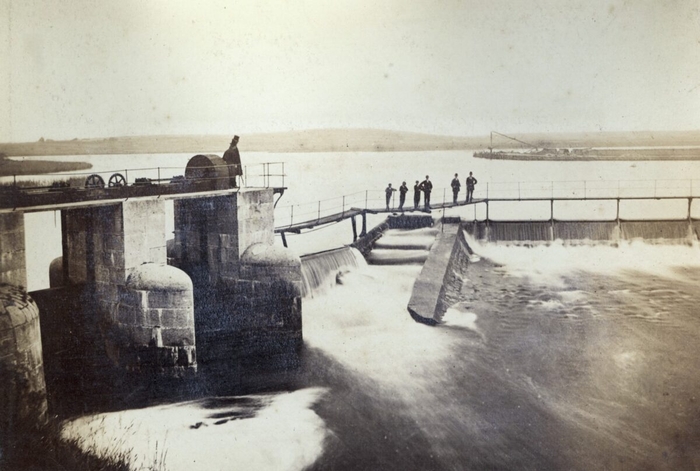
In typical fashion, he then tried to inspect the salmon ladder from the point of view of a salmon who would be using it, and lowered himself down from the platform. “I observed that the water from the lake came through the opening in a solid, quiet-looking board-like mass, but once on the steps of the ladder, it bubbled and boiled like a young Niagara. I thought I would for a moment, just try and see what sort of sensation the salmon experienced when making their headway through the cataract. Oh! That I had the scales and fins for five minutes thought I; never mind, I must do without them. I then stepped into the ladder, but as quickly scrambled head over heels out again for the water was terribly powerful, tripping up one’s feet in a second. So I chose the corner of the ladder where the water bubbled around and sat there in state, wishing and trusting that some salmon would take it into his head to ascend the ladder while I was there”.
All of this activity in broad daylight could clearly be seen by those onlookers who were watching from the bridge, including the Ashworth’s own bailiffs, who had not been warned of their visitor’s intentions. As Buckland described it, “Presently I heard a voice behind me. ‘Bedad, your honour, you’re the finest fish I have seen in this ladder this long time; and, by the powers, if I had a gaff in my hand, I’d just strike it into your scales and see how you would like it.’ I looked up, and there was one of the water bailiffs, who, watching me from afar off, could not imagine what curious white-skinned creature had got into the ladder and was floundering about in it.”
All of this activity endeared him to the general public in Galway, who became fascinated with the work he was doing in re-organising the layout of the Salmon Weir. At the time, The Protestant Mutual Improvement Society were completing the construction of their new rooms in Woodquay, and Buckland was invited to give the inaugural lecture there. It was such a success that they decided to name the premises Buckland Buildings. It later became known as the Parochial School.
Much of the above is taken from an article written by Tim Collins in the Galway Archaeological and Historical Society, Volume 55, 2003.