On this day, the 14th of August in 1958, the Dutch KLM Super-constellation airliner named Hugo de Groot crashed into the sea about 100 miles off the Conamara coast with the loss of 99 lives. The flight was on its way to New York from Amsterdam via Shannon with 91 passengers and eight crew on board. Nobody survived the tragedy. It was the worst disaster involving a single plane in the history of aviation up to that point.
The aircraft took off from Shannon at 4.05am and at 4.40 it had passed 12,000 feet. The last radio contact was at 4.42 and “the operator’s voice was clear and normal at the time of contact”. Then radio contact was lost, so Shannon contacted Gander Airport in Newfoundland. Gander initially thought there had been radio contact with the plane and on realising this was not true, a full scale alert was launched. A Pan-American World Airways cargo plane en route westward across the Atlantic said it had intercepted an SOS, it being about 450 miles east of Gander at the time.
That afternoon, at about 3pm, an RAF search plane sighted some wreckage about 80 miles off Slyne Head and immediately, 14 vessels of different nationalities abandoned their normal duties and headed to the scene of the crash. The Naomh Éanna was about to leave for Aran with a few hundred passengers when the Mayday call came through. They disembarked the passengers and headed straight for the crash scene. It was dark when they got there but the sky was lit up by RAF flares. Because the boat was high up in the water, some of their personnel had to climb down rope ladders to recover wreckage, body parts and lumps of human flesh. The Aran life boat made several attempts to come alongside to transfer nine bodies they had on board but the seas were too rough. In fact, the life rail of the life boat was smashed.
The search went on for 48 hours, after which “there was nothing left to search for”. Only 34 bodies were recovered, nine of them male, 25 female, all of them passengers. None of the crew were found.
Galway was mobilised and that Thursday night, units of the Red Cross and The Order of Malta waited at the dockside accompanied by several hundred civilians, all praying that there might be some survivors, but as the night went on that hope gradually faded.
The following day, at about 6pm, a French trawler the Jules Verne was the first of the mercy boats to enter the docks. They were soon followed by another French trawler the Bisson and a Canadian destroyer transferred two bodies and some wreckage into a smaller boat out in the bay. All the boats sailed into the docks with flags at half-mast. The sheer size of the crowd made the situation dangerous as they were leaning over the dockside trying to look in to the boats so one of the boatmen pulled back some of the tarpaulin covering some of the remains at which the crowd recoiled back from the edge and gave them the space to unload their grim cargo.
The bodies were taken ashore by the Red Cross and the Order of Malta helped by the Fire Brigade and the Civil Defence Corps. The remains were taken to the Regional Hospital by a fleet of ambulances and the Civil Defence Mobile Unit. All through the night, Dutch and Irish doctors carried out post mortems. KLM and Dutch Government investigators arrived in Galway and began sifting through the wreckage looking for clues to try and identify the cause of the disaster.
At an inquest held in the ballroom of the Great Southern Hotel, Dr John Kennedy, pathologist suggested that the plane plunged into the sea at high speed, and ruled out the theory that there had been an explosion aboard. A verdict of death by multiple injuries, fractures and haemorrhages was returned. The remains of those whose bodies had been identified were returned to their native countries.
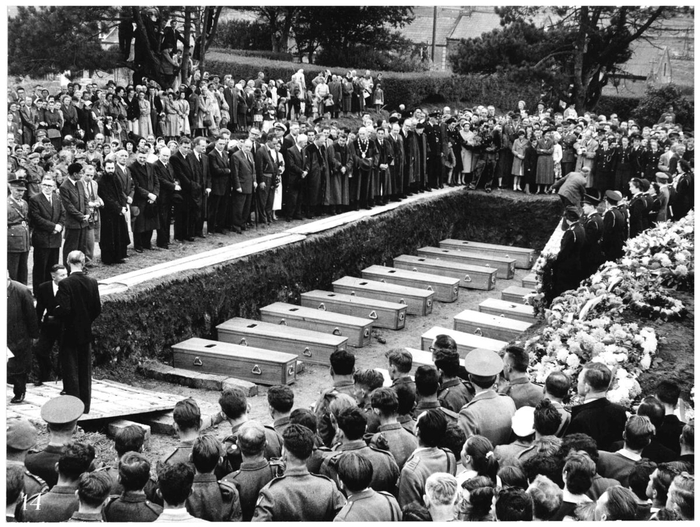
The remains of the 22 unidentified victims were interred at the new cemetery on August 19. There was a service outside the mortuary at the Regional Hospital with prayers said by clergy from the Muslim, Jewish, Catholic and Protestant faiths. Then soldiers from An Céad Cath placed the coffins in hearses and army vehicles and led contingents from Civil Defence, the Red Cross and the Knights of Malta followed by the cortege through the city. Behind the hearses came the next of kin, church dignitaries, members of the Diplomatic Corps, nurses, the city council and those present in an official capacity.
All of the church bells in the city tolled, all of the businesses closed, 10,000 people lined the streets, kneeling and praying. Many wept openly. The internment took place without any further rites.
Our photographs show the funeral cortege making its way through Eyre Square and the scene in the graveyard as the remains were being laid to rest.