Yeats’s return
Thu, Sep 17, 2026

William Butler Yeats died in the Hotel Idéal Beauséjoue in Roquebrune-Cap-Martin in France on the January 28, 1939 aged 73. His wife Georgie and himself had often discussed his death, and he told her, “If I die, bury me up there at Roquebrune and in a year’s time when the newspapers have forgotten me, dig me up and plant me in Sligo.” His funeral was a discreet and private affair. His body was later exhumed and removed to the ossuary. Because of the outbreak of the war, it was not possible to bring his coffin back to Ireland for several years.
Read more ...As others saw us
Thu, Sep 10, 2026

Last week we showed you some very well researched watercolours of Galway painted in the late 1830s by William Evans of Eton. He had made many careful studies of the types and colours of the clothing worn by native Galwegians, especially the women; of the different types of baskets they wove; the traditional everyday tools and equipment they used such as sleáns, milk churns, cooking pots and spinning wheels; the types of traditional boats they sailed.
Read more ...William Evans’ watercolour studies of Galway
Thu, Sep 03, 2026

William Evans of Eton (1798-1877) was the drawing master of Eton College in England and an accomplished artist who exhibited widely in London, Dublin, and Paris. He made several visits to the west of Ireland in 1835 and 1838, where he produced many studies and finished watercolours, mostly of Counties Galway and Mayo, a mixture of picturesque landscapes, market and street scenes, and what might be called peasant structures and peasant portraits.
Read more ...De Burgo’s mansion
Thu, Aug 27, 2026

This wonderful photograph, dated c1865, shows a carved stone doorway in Market Street, an interesting example of Renaissance work, almost certainly earlier than the Browne Doorway.
Read more ...Student-led Galway hackathon puts Ireland’s next generation of innovators to work on real city challenges
Thu, Aug 27, 2026

Young people from across Ireland came together at PorterShed in Galway for FutureHack, a student-led hackathon challenging 13 to 19-year-olds to develop practical ideas for making Galway a better place to live.
Read more ...Student Union appeals for accommodation ahead of new college term
Thu, Aug 27, 2026

As 20,000 University of Galway students return to college on September 7, the Students’ Union is appealing to the public for help finding students accommodation.
Read more ...Galway Hospice calls on communities to host a coffee morning this September
Thu, Aug 27, 2026

Galway Hospice is calling on people across Galway to put the kettle on this September and host their own Coffee Morning in support of local hospice care.
Read more ...Galway Courthouse
Thu, Aug 20, 2026

“This fine building, which is superior to most Provincial seats of justice in Ireland, stands at Newtownsmith on the site of the ancient and venerable abbey of the Franciscans, which by the Charter of Charles II ‘is to be and remains part of the County of Galway forever’. It was commenced in 1812 and on the 1st of April 1815, was opened for the reception of the then going justice of assize……
Read more ...Forty years of Macnas
Thu, Aug 13, 2026

Macnas, noun: The frolic-like behaviour of a young calf let out to grass for the first time after being kept in all winter; joyous abandonment; dalliance, wantonness.
Read more ...The Streets Of Galway road race
Thu, Aug 06, 2026
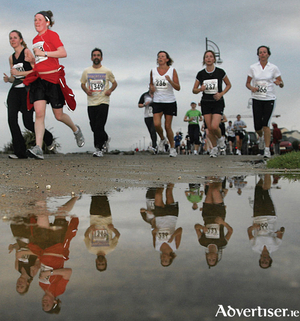
The inspiration for this race, which was run for the first time on August 15 1986, came from that great sports man Jack Mahon who had attended a number of such races in different parts of the country. It was run under the auspices of Clare River Harriers with a B.L.E. licence. It was a race designed for all the family with a central theme of “Sport for All” and was described as a ‘fun run’; there were no elite prizes but local businesses sponsored right down the field. There was a big display of the medallions for all the category winners in the window of The Great Outdoors.
Read more ...The Sword and Mace
Thu, Jul 30, 2026
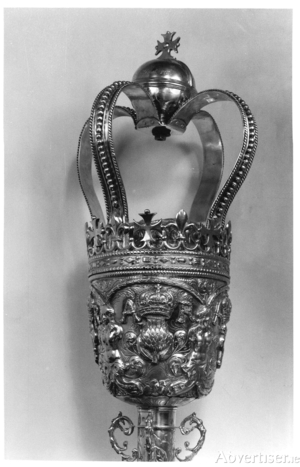
The Galway civic sword and mace are among the finest specimens of municipal corporation insignia in Ireland; the sword in particular is noteworthy and can be compared with the best of civic swords in these islands.
Read more ...The National Bank
Thu, Jul 23, 2026
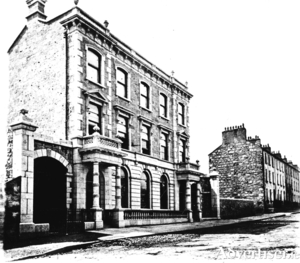
The Galway Vindicator of October 3, 1866, contained the following report … “For some four or five years now, The National Bank has had in its possession a plot of ground on the east side of Eyre Square directly opposite Forster Street and adjacent to the Provincial Bank, which was purchased from the proprietor Mr Levingston for £600, for the purpose of erecting thereon a new building, the present bank being in St Augustine Street which was considered too backward for the improving business of the concern in Galway.
Read more ...Lower Salthill, 1953
Thu, Jul 16, 2026
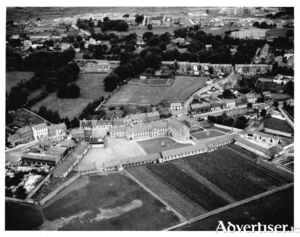
The Galway Vindicator of November 24, 1863 reported that “The completion of the Grattan Road will add much to the beauty and salubrity of the handsomest of our suburban districts. The embankment being made by Miss Grattan will reclaim 28 acres of land which is now a swamp, but which will become, with little cultivation, some of the most fertile ground in the neighbourhood. In the past season of distress, Miss Grattan has given great employment to the poor of the neighbourhood in making this road and embankment. Since June last, up to the present time, there have been over 200 labourers employed and from 12 to 14 masons regularly. It will, when finished, alter the appearance of Salthill and contribute much to make that favourite place one of the nicest locations in the kingdom”.
Read more ...The ultimate game
Thu, Jul 09, 2026

In Séamus King’s remarkable book The History of Hurling, there is a reference to hurling being played as far back as 1,200 BC in Tara, Co Meath. The earliest written references to the sport in the Brehon Laws date from the fifth century. It was played in ancient times by teams representing villages, involving hundreds of players, and the match might last several hours, even days.
Read more ...A history of Our Lady’s Boys Club
Thu, Jul 02, 2026

In the 1940s the seeds of great social change were sown in Ireland; Irish society began to “feel the full force of the cold blast of social change”. In 1940s Ireland, the State gave no assistance to the out-of-school education of young people. The need to provide social and recreational activities for young people was enormous. The Jesuit Community responded to this need by setting up Our Lady’s Boys Club in 1941, which began to provide organised recreational activities to the youth of Shantalla, Bohermore, Claddagh and ‘the West’.
Read more ...Bohermore/Grealishtown, 1950
Thu, Jun 25, 2026

This aerial photograph shows the main road into and out of town – An Bóthar Mór – c1950. You can see the end of the terraces, the hat factory and to the right, Grealishtown.
Read more ...St Patrick’s Brass Band, 130 years
Thu, Jun 18, 2026

One of the most enduring of Galway institutions is this band, which has given much pleasure to its own members and countless thousands of the public since it was formed in Forster Street in 1896. The founders were Peter Rabbitt, a Forster Street publican, Michael Spelman, who worked in Moons and Paddy Walsh, the Station Master. It was originally a Fife and Drum band.
Read more ...Nostalgia for The Hangar
Thu, Jun 11, 2026

Salthill Park was originally a large field with a small lake. It was landscaped in 1907, but a cesspool developed there. The newly formed Salthill Development Organisation asked the Urban District Council to clean it up, and eventually, after some years, they did.
Read more ...Galway Gardaí, a brief history
Thu, Jun 04, 2026

The Royal Irish Constabulary (RIC) was founded in 1822. For organisational purposes, Galway was divided into two districts, East and West, commanded by two inspectors who reported to the RIC Commissioner in Dublin Castle. From its foundation, the force faced particular challenges in Galway due to the persistence of land hunger among the poor, who organised themselves into secret societies and resorted to cattle driving and violent disputes over land. As a result, County Galway had the highest concentration of police in the entire country.
Read more ...Reunion of the Bish classes of 1965 and 1966
Thu, May 28, 2026
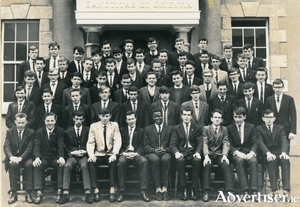
Two hundred years ago, in October 1826, the Warden of Galway wrote to the Superior of the Patrician Brothers asking him to send at least one Brother to Galway to take over a school which had been moved from near the Shambles Barracks to a disused barrack in Lombard Street. Brother Paul O’Connor and Brother Dawson were sent to Galway. Cash in hand was one shilling. Social conditions were very bad, but the Brothers went ahead and established the Monastery School, known as The Mon. Before the school had been a year in operation, the improvement in the youth of the city was so evident that a public meeting was held in the school to vote thanks to the teachers, “whose zeal, attention and excellent arrangements had produced such happy results”.
Read more ...