
William Evans (1798-1877 ) was the drawing master of Eton College in England, an accomplished artist who exhibited widely in London, Dublin and Paris. He made a number of visits to the west of Ireland in 1835 and 1838 where he produced many finished watercolours and studies, mostly of Counties Galway and Mayo. His subject matter varied from panoramic landscapes to market and street scenes, and what might be called peasant structures and peasant portraits. He painted a lot in Conamara, especially in the vicinity of Renvyle and was among the very first artists to show off this wild remote area in his pictures.
In Galway city, he concentrated his work on the Fishmarket and Claddagh areas though he also did some beautiful paintings of Buttermilk Lane and Kirwan’s Lane, both of which have already appeared in this column. His are evocative images that record the actuality of life for ordinary people, important historical documents that capture the character of and the atmosphere on Galway streets before the Famine. What makes them stand out from other 19th century images of the Irish landscape is their freshness of colour, expressiveness and vitality alongside their topographical accuracy.
He carefully studied the types of clothing worn by the locals and also the everyday traditional tools and equipment used by them such as sleáns, milk churns, various types of baskets, cooking pots and spinning wheels.
Henry Inglis published his guide A Journey Throughout Ireland in the Spring, Summer and Autumn of 1834 and this book almost certainly influenced Evans. According to Inglis writing on the Claddagh, about 1,700 fishermen lived in this ‘baile’ with their wives and children. “I looked into hundreds of cabins and there was scarcely one in which I did not see the females busily engaged in spinning, making or mending nets. These, they make not only for use, but for sale. An air of decency was visible about them all. I saw none without chairs and bedsteads and a respectable display of crockery.” Many of Evans’ studies of interiors and figure studies were done in the Claddagh area.
Our first illustration (above ) is of one of his paintings of such a cottage interior and shows a woman busy spinning wool on her big wheel while, behind her, a man sits on the edge of a raised bed in its customary place against the back wall adjacent to the warmth of the fire. There is a large pot boiling suspended over the fire and you can see an axe and bits of timber waiting to be chopped and added to the flames. The girl in the background is probably helping her mother as she stands in front of a simple dresser.
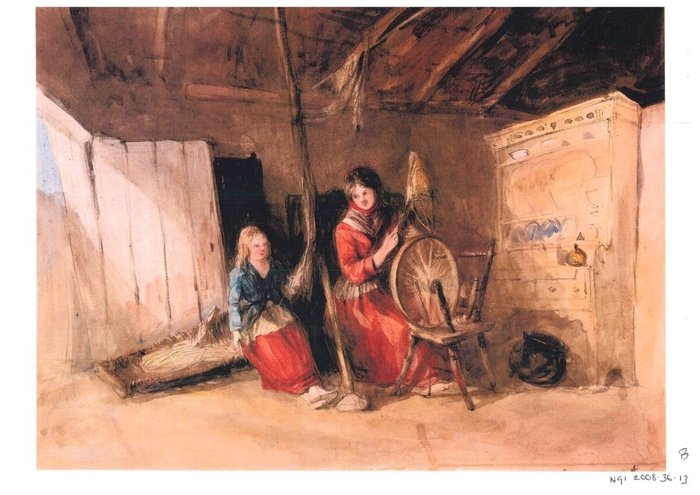
Our second image (B ) is of a different cabin interior where the lady is spinning flax by the light of the half door, being helped by her daughter who is seated on a bed. The lady is wearing a red petticoat and a red top with a wraparound stole, her daughter is in a red petticoat and the more traditional blue top. To the right is a dresser, with the cooking pot tucked underneath, leaning up against a partition wall. You can see part of the fireplace in the background.
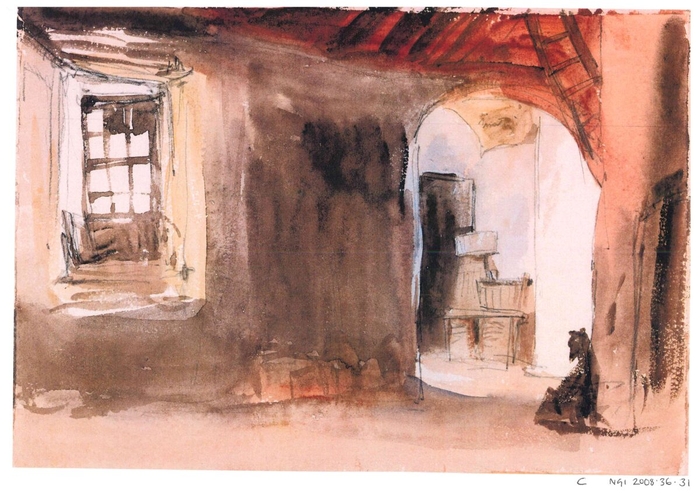
Our final painting by Evans (C ) is of a sparse interior with very little furniture. The thickness of the walls can be seen by the window. There is a fireplace on the right hand side which is why the dog has placed itself there. There is part of a ladder hanging from the ceiling, just behind the fireplace. In the far room, what looks like a washtub perched on a small table, and what may be a dresser in the background there.
Our first illustration is taken from Irish Rural Interiors in Art written by Claudia Kinmonth, and the other two are shown courtesy of the National Gallery of Ireland.
