****
Train Dreams is Clint Bentley’s sophomore directorial effort after helming the well-received indie drama Jockey (2021 ). He also received an Oscar nomination for co-writing Sing Sing (2024 ), directed by Greg Kwedar.
This is the third instalment in their ongoing filmmaking partnership with Kwedar back on co-writing duties after performing that role in their previous two films. Despite having not seen Jockey (2021 ) due to its limited release, one can see Bentley’s personality and voice all over Sing Sing when compared to Train Dreams. It seems as though Bentley and Kwedar are on the same wavelength with their desire to explore sensitive male characters struggling with the weight of living.
It is rare nowadays to see a filmmaking team which has executed its minimalistic vision successfully, without being hindered by the films’ anti-commercial nature. Sing Sing’s critical acclaim and accolades undoubtedly earned them some esteem in the industry, and I hope that this film musters the same response.
Adapted from Denis Johnson’s 2011 novella of the same name, Train Dreams recounts the story of professional logger, Robert Grainier. It records people he meets, and the experiences he has – both enriching and debilitating – and how he endures in a rapidly changing 20th century.
If a film can stand out from the crowd, ignore industry fears around low attention spans, and stay true to its vision, it will earn my respect. What Clint Bentley makes here, is an act of defiance: a film that moves at its own measured pace, with a quiet, pensive protagonist at its centre, and rejecting typical narrative. It is ironic that Netflix bought the distribution rights after its initial recognition at the Sundance Film Festival, because it is exactly the type of immersive, transportative film that should be seen on the big screen. Unfortunately, cinemas around Galway didn’t agree because it was not screened once, much to my frustration.
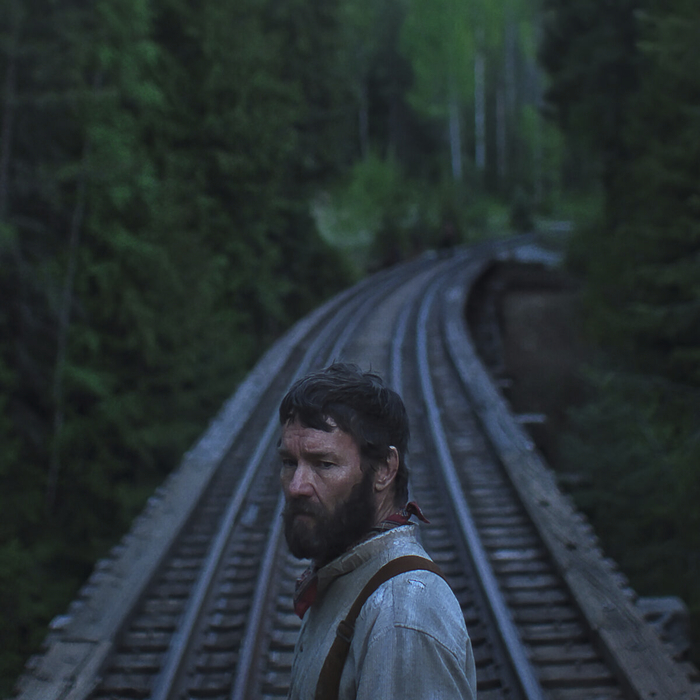
As mentioned above, the style is unconventional. Despite its fictional nature, Robert’s moving story is narrated in a novelistic style, giving us insights into his thoughts while the naturalistic cinematography and framing of the character compliments appropriately, making it easy to form an emotional connection. He is very much a small part of a large, unpredictable world, and the film captures that well.
When with his family, the camera is close and personal, capturing his happiest moments. The sheer verticality of trees and forests, when away at one of his extended logging jobs, shrinks him down, emphasising his insignificance in nature. These purposeful decisions are evocative, and despite the 20th century period setting, many will relate to the isolation and detachment which Robert’s character feels.
The film succeeds at garnering empathy in large part due to Joel Edgerton’s quietly devastating performance.
He is an actor who has become one of my favourites in recent years, with performances in It Comes at Night (2017 ), The Master Gardener (2023 ) and miniseries, The Underground Railroad (2021 ). He commands attention with very little animation or change in volume. His eyes especially draw you into the character’s introspection, encouraging sympathy. He captures Robert’s innate innocence, and the fact that he is just another ordinary man who, like many others, had lifelong trials and tribulations.
Some might criticise the reliance on sentimentality to achieve the film’s desired, emotional effect, especially in the third act. While I understand that to a degree, the sincerity of the performances and dialogue really worked for me, lessening the extent to which it detracted from the overall film.
Special mentions to actors William H Macy and Kerry Condon who fit this world like a glove. Their screen presences bring levity and hopefulness, making the film’s exploration of an entire life feel well-rounded.
Now showing on Netflix.