In 1822, the harbour of Galway was very defective with only one small dock, now known as ‘the mud dock’, and two small jetties on the Claddagh shore. The outflow of the river was too great to allow sailing boats to enter safely at low tide. They had to wait outside on the roads for high tide, and even then, the entry could be tricky when the wind was strong. The merchants of Galway petitioned the Lord Lieutenant in 1820 to make improvements and he forwarded their request to Nimmo.
Alexander Nimmo was a Scottish civil engineer and geologist who came to Ireland to work for the Commissioners for the Reclamation of Bogs. In 1820, he was employed by the Irish Fisheries Board to make extensive surveys and recommendations for Irish fishing harbours. He built numerous piers and bridges in the west of Ireland and was also responsible for the construction of Roundstone and Belmullet. “No man so well understood the remedies required for the practical evils of the west in particular and the effects will be felt long after his remembrance has passed away.”
He saw immediately what needed to be done in Galway; the Claddagh fishermen needed a quay and a proper place to draw up their boats in safety; the whole harbour needed better protection from the west and southwest, together with a new floating dock; and the town needed a canal joining the harbour to Lough Corrib. At the time, the boatmen of Menlo used to haul their boats across town to the sea when the herring season started. He put men to work immediately, deepening the Claddagh beach, raising the jetties and making a rough quay along the shore in front of the Claddagh Church, thus giving much needed employment locally.
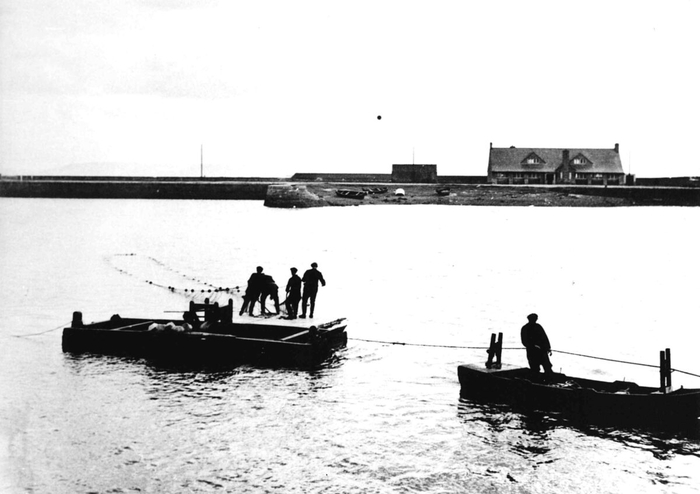
His main priority was to increase the shelter of the harbour by erecting a breakwater along the rocky outcrop known as ‘The Slate’ at the west end of the entrance. It was to be 500 feet long with a return of forty feet at its head, constructed of hewn limestone from Aran with a sloping pavement to seaward, as shown in our first photograph. The work started in 1820 and was completed by 1827, giving the harbour considerable shelter and contributing greatly to its general usefulness. Our second photograph shows part of the breakwater, now known as Nimmo’s Pier c1920. The Claddagh Hall, which features in the photo was built in 1912.
The breakwater was detached from the land but was continuous with a long spit of gravel along the open shore that stretched westwards. To get to the new breakwater, it was necessary to cross a creek and marsh of about 20 acres overrun by high tides in the area between the gravel spit and the village. This is the area known as ‘The Swamp’ today and can be seen in our third illustration.
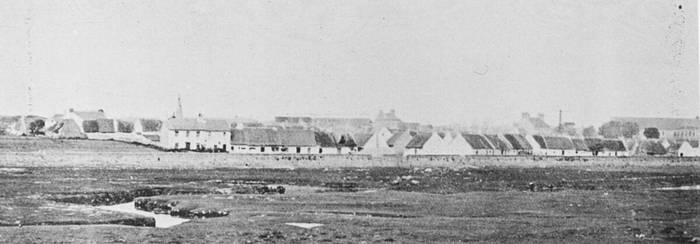
Nimmo proposed to build an embanked road 300 yards long across the marsh and creek, joining the breakwater to the village and providing more quay space for boats. In this, he planned an opening, crossed by a stone-arched or a swivel bridge, leading into the creek and marsh, transforming them into a five-acre dock for fishing boats. The gravel pit could easily be raised above the high tide level giving extra protection to the new dock. It would have cost £1,000 and would have made a tidy small harbour for the Claddagh in what is now known as South Park, but it was never pursued. The spit was raised and the marsh subsequently filled in.
This site of Nimmo’s proposed harbour became a municipal dump in the last century and was eventually, in the 1950’s, converted into what we know as ‘The Swamp’ today. For a long time after the pitches opened and matches were played there, players were asked, if they saw any bits of broken glass or parts of tin cans, to pick them up and leave them at the wall. Many was the player who went straight to the Regional for a tetanus shot after coming into contact with these sharp remains of the town dump.
All of the above information comes from a wonderful book titled Alexander Nimmo, Master Engineer written by Professor Noel Wilkins.