Leaning against the railing of the ferry as the wind licks salt into my hair, I consider whether letting the lads babysit the dog was a bad idea. But I can’t suppress the excitement of being out of the city.
I’m going to stay with my friend Gael McDonagh, whose family is from the island and runs a café. Gael is to compete in the Rásái – the annual currach races – with their mum, Una.
At the pier, Gael finds me with their lovely dog, Lily. When Gael is done working, we go for delicious sandwiches and an afternoon pint at Tigh Ned’s. Passing the bar, they point out the island lottery, currently at its limit of 10,000 euro.
As we play darts, Gael tells me about the Plassey shipwreck and the Rásái: “it’s the biggest weekend of the year, for islanders at least.”
Currachs, originally essential to island life, were used for transport, fishing, and cargo, capable of navigating rough seas. The racing tradition has been preserved in the West – and on Inis Oírr, when the Rásái brings many people home for the weekend.
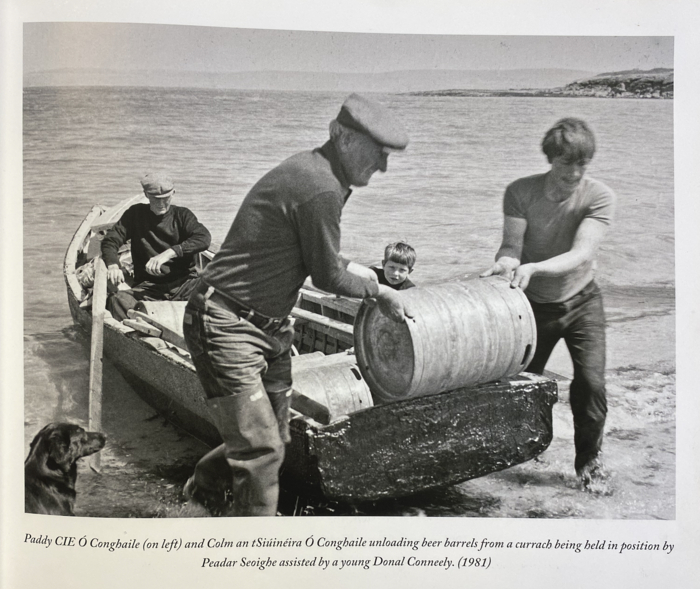
Chatting to Gael’s dad, John, he tells me there’s a misconception that the people of the island are “one big happy family.” But at the same time, “the people of Inis Oírr are some of the most welcoming in the world.”
Back at Ned’s that evening, Gael tells the bartender to give me a “kind pour” of my choice (a strong Aran Island Whiskey ). People dance to the trad session. Outside, at least one dog is making the rounds, drinking Guinness straight from any pints offered.
“Welcome to the island,” a new friend tells me as they insist on paying for my drink. On the very short walk back to our lodging, the stars are captivating – so many more than in Galway.
Observing that day, the obvious underlying tension is of course the local – tourist divide. Island residents rely on summer traffic to balance the budgets, and the opportunities it brings have created a significant revival in population. Inis Oirr is the only island to show an increase in residents in the last census. But tourism is a double-edged blade.
The treated water supply on the islands has been under severe strain this summer, with the lack of rainfall, warm weather, and heavy tourism. Though the annual rainfall is enough for islanders to subsist on, the reserve can’t accommodate the number of summer visitors.
Like Inis Mór, Inis Oírr has been under nighttime water restrictions. The situation has been exacerbated by a crack in one of the reservoirs, meaning water has to be shipped out, a costly and inconvenient arrangement.
On the matter of tourists themselves, the islanders I speak to say that despite the poor reputation of Americans, it’s actually Irish visitors that irk them the most. As Gael explained to me, “at least the Americans know they’re not from here.” Irish people from the ‘mainland’ often have a false sense of familiarity, especially if they visit annually.
Next to me in the café on the morning of the races, an Irish family eats scones, backpacks tucked under the table.
“Those tables are reserved for all these tourists,” says the mum with disdain, nodding at the section of the café roped off for Una’s walking tour. A few minutes later, without irony, the dad asks jovially: “Okay, what’s the next step on our holiday?”
But while I’m told there are more visitors than usual, the Rásái has a distinctly local feel. Lots of young families are speaking Irish, likely full time residents. Children play in the water and small dogs dig big holes on the beach. There are upwards of two hundred people. “This is like it would have been years and years ago when there were festivals,” says a woman next to me.
The Rásái moves on “island time” – which is to say, begins at least an hour behind schedule.
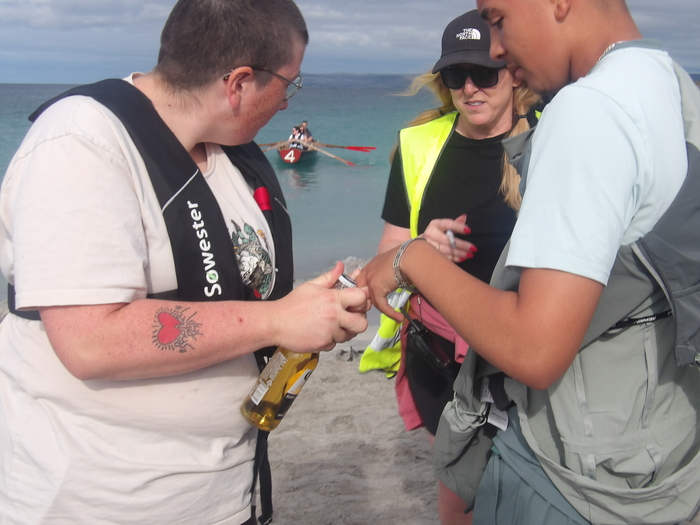
Caption: Gael attempts to open a lad's bottle with his ring while a race organiser asks for a light. (Photo: Gráinne Greene )
As the boats push off into a teal blue sea, I’m amazed by the pure difficulty of the rowing. The water is calm, but the oars are very narrow, and the race buoys awfully far. (Gael does not win their race, but “there’s always next year.” ) People cheer while car horns blare for the boats running back onto shore.
After the races, speeches are made in Irish. More than a few tears are shed, as this is the first Rásái following the tragic loss of islander Joe Joyce right before the races last summer. The Under-18s race is now dedicated to him.
Out and about that evening, two locals are turning 21, and the pub is transformed into a disco. “Not really traditional,” someone grumbles, but others enjoy it. “I haven’t had a night out like this in a long time,” confides Gael’s cousin with delight.
After a night of gallivanting, I head back to the gaff, glad to have come out here. Considering my takeaways of the weekend, I think of earlier in the day, up by O’Brien’s Castle.
Stepping off the lane to let a tractor ridden by three auld fellas pass, a retired American couple chuckled. “I should have gotten a picture,” said the man. The woman agreed. He shook his head, gushing: “That was quintessential!”
What struck me about those tourists is that they think the island – and by extension, Ireland – is of the past. They think that the “heritage at risk” is the decomposing Plassey, the paddy caps, the relics of history.
But in my experience, the heritage of Ireland is something lived. And in an era where young people are emigrating away in droves, it’s not just the tradition at risk, but the capacity to carry it on.
So sitting on a wall at half three in the morning, watching a wooden pallet bob along the sea road as someone carries it toward a crackling bonfire and the promise of youth, I see something just as quintessential to this culture.