A seven foot, bronze statue celebrating the mythical princess who drowned in the Corrib and gave her name to Galway, is languishing in a plywood crate, in a back yard, in Wicklow.
The long-anticipated sculpture Gailbhe, by renowned sculptor Alan Clarke, was supposed to be erected on the city’s newest bridge, Droichead an Dóchais, two years ago, but a breakdown in the relationship between the artist and Galway city council means the project is in limbo.
“The sculpture has been ready since early September, 2024. I sank my heart and soul into it, and I consider it to be one of the finest pieces of work I have created,” says Clarke, the only Irish person ever accepted into the Society of Portrait Sculptors, an exclusive, 73-year-old society with just 55 members worldwide.
“It languished for almost a year in the foundry in Dublin where it was cast, and since then has been in a crate in my garden in Wicklow. As of the week before last, I have withdrawn from the project,” Clarke told the Advertiser.
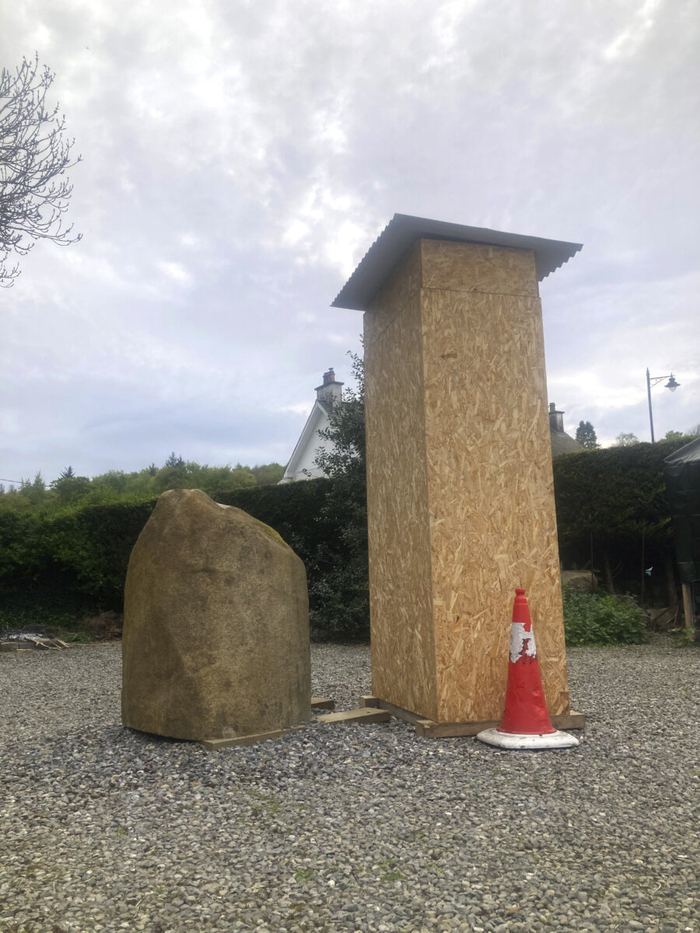
Clarke, who is well-known in popular culture for his illustration of the Ross O’Carroll-Kelly series of books by Paul Howard, has high praise for the efforts of individual officials in City Hall, but condemned the bureaucracy involved in getting the project to move on. He won the almost €50,000 commission in 2023, after he and 26 other artists submitted expressions of interest to an evaluation panel of multidisciplinary experts.
“I would struggle to put into words what it has been like dealing with Galway City Council,” he said.
“It is my sincere hope that this sculpture will still end up in Galway. It was designed for Galway, and is symbolic of Galway. I believe it will bring some joy to the city, for it to be sitting in a crate is a very sad state of affairs.”
A spokeswoman for Galway city council said it is still engaging with the artist to finalise the piece, but has not yet decided exactly where to site Clarke’s depiction of Galvia – as she is known in Latin: the mythical Firbolg daughter of Breasail who fell into the rushing Galway River, renamed the River Corrib in the nineteenth century.
A pictorial map of Galway from the mid-seventeenth century shows an outcrop on the river’s western bank, where Weir House is now, with a note that this is the location of Galvia’s drowning.
According to Brendan McGowan’s Galway Stories, the rock survived into the 1840s, when townspeople proposed erecting a stone pillar with a bilingual inscription on it as a monument to the drowned girl.
This never materialised, and the rock was dynamited in the 1850s to make a foundation for Weir House, which now houses the Galway County Club.
“A precise location has not been identified, as the siting of the sculpture is dependent on the finalised piece, and regulatory requirements,” said the council’s spokeswoman. “The artwork was commissioned by Galway City Council, and payment towards a portion of the costs [has] been received by the artist as is standard practice in such projects. Title to the artwork has not yet transferred to Galway City Council, and the work remains in the artist’s possession at their studio.
“Galway City Council and the artist are currently engaged in discussions regarding the future of the commission. It would not be appropriate to comment further at this time.”
The 85 metre Salmon Weir Pedestrian and Cycle Bridge, Droichead an Dóchais, was a €10 million project, and the first new bridge over the Corrib in 30 years after its official opening in 2024. Short-listed for international architecture and engineering awards, it spans waterways on three different levels: Friars’ River, the River Corrib and Distillery River. From above, it is shaped like a salmon.
The bridge, linking Newtownsmith with Nuns Island, was funded by the Department of Transport through the National Transport Authority’s (NTA ) Active Travel Programme, alongside €3.5 million in European Regional Development Funding (ERDF ) from the EU.
The €47,700 Galvia commission was delivered through the Percent for Art Scheme as a portion of the bridge’s overall capital funding, with the new sculpture managed by the Arts Office of Galway City Council. A number of precise sites on and nearby the bridge for the princess, whose exact depiction is a closely guarded secret, are understood to have been identified.
Last year, the NTA pulled funding for a second new pedestrian and cycle bridge. It would rest on the abutments of the historic Clifden Railway Bridge in Woodquay, but in February, Galway city council said it had secured an allocation from the government’s Urban Regeneration and Development Fund (URDF ) to bring the bridge to planning stage. If built, it will form part of the 76km Connemara Greenway.