Across East Africa, life is fragile, yet it pulses with courage, resilience, and quiet hope. In northern Ethiopia, a mother gently cradles her child, weakened by hunger. In Somalia, parents cling to memories of little ones lost, holding onto the fragile promise of brighter days. Grandmothers in parts of Northern Kenya walk miles carrying the weight of hardship and the wisdom of generations.
Families uprooted from Tigray and Darfur leave homes behind, yet carry an unbroken determination to survive. From Ethiopia to Somalia, Sudan to Eritrea, Kenya to Uganda, communities face hunger, climate, and conflict. Still, amid this struggle, hope flickers. For nearly forty years, I have travelled across Africa and the developing world, witnessing the extraordinary strength of ordinary people: mothers learning new ways to feed their families, communities planting trees to nourish generations, children discovering joy even in hardship.
My daughters, Mia and Sophie, remind me daily of the enduring humanity that binds us across continents. And though the challenges are immense, I have seen what compassion and solidarity can achieve. After my latest journey, I return with a heavy heart and a steadfast belief that with care and collective action, Africa can rise, even in crises too often overlooked.
The climate is changing, and Africa feels it most. Drought dries wells that once sustained generations. Floods sweep away homes and harvests. Crops, sown with hope and sweat, vanish under heatwaves and locust swarms. Farmers who relied on the seasons now face a world that seems to have forgotten them. Families live in the impossible choice between which child eats and which goes hungry.
Hunger here is not a statistic. It is a daily, unbearable reality. I have walked this land. I have met mothers who have gone days without food so their children could eat a single meal. Fathers who once tended proud farms now stare at dust where crops should grow, cattle lying dead in the sun. I have seen rivers dry to bone, villages washed away, wells run empty. I have held children in my arms whose eyes carried both joy and a quiet sorrow far beyond their years. These children are not numbers, they are life itself, held fragile in the hands of those who love them most.
“Please don’t look away. Our children are dying.”
In villages across Ethiopia, Uganda and Kenya, where I travelled mothers spoke words no one should have to speak: “We feel forgotten. Please don’t look away. Our children are dying. We need water. We need food. Please help us.” And in their voices, I heard the truth of a world that is burning, melting, flooding, starving. Hunger is not natural, it is human-made, fueled by war, conflict, climate,and neglect. No child should die because the world looked elsewhere. No family should go hungry because rains no longer fall. No region should be left to suffer in silence. Yet even here, hope endures. In the cracked earth and scorched fields, I see mothers planting, communities gathering, children learning to laugh again. Love persists. Courage persists. And if we do not look away, if we act together, perhaps life can rise again, stronger, greener, brighter across this beloved land.
And then — the cruelest blow: Aid cuts.
Just as the crisis deepens, just when the suffering reaches its peak, wealthy nations have pulled back. Key donors have cut aid budgets, suspended life-saving programmes, cancelled climate, agriculture, and health funding, and left millions abandoned. Projects that were restoring hope — cancelled. Jobs for African development workers — lost. Irrigation systems, community water schemes, livelihood programmes — frozen. It is, quite simply, devastating. Heartbreaking. Soul-destroying. And yet, amidst the heartbreak, I carry deep gratitude that Ireland has not walked away. Irish Aid, the development arm of the Irish Government continues to stand with the poorest families on Earth and their support and unequalled commitment is saving lives every single day. It makes me profoundly proud to be Irish. As a Ugandan farmer said to me recently, “Ah you’re from Ireland, the most caring country in our world.” But in a world of compounding crises such wars in Ukraine and Gaza, tense global economies, climate disasters everywhere, the people of East Africa fear they have slipped from our moral imagination. Millions, especially those in wartorn areas, are asking only one question: “Does anyone remember us?”
And then… something beautiful happened. Something powerful. Something deeply Irish. At a time when East Africa is crying out for solidarity, 30 GAA heroes, some holders of All-Ireland medals, All-Star champions, legends of our sporting culture, stepped off a plane in Uganda with mud-ready boots and hearts full of fire.
They came for Plant the Planet, the extraordinary partnership between Self Help Africa, the Gaelic Players Association, and Warriors for Humanity led by the remarkable Alan Kerins. “Every tree planted represents a livelihood,” said Kerins. “Families and schools who receive the trees will own them. They will help farmers grow themselves out of poverty.”
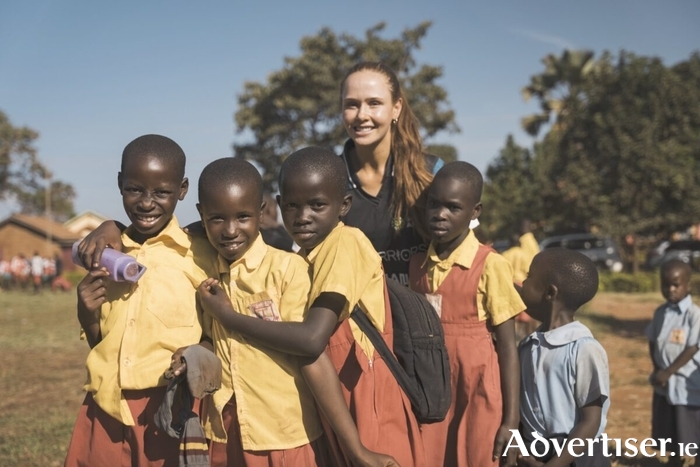
Imagine the scene, Limerick’s David Reidy handing a young Ugandan farmer a tree seedling that will feed her family for decades. Mayo’s James Carr sweating under a blazing equatorial sun, digging holes alongside schoolchildren in Jinja. Cork All-Star Saoirse McCarthy and Galway All-Star Olivia Divilly smile as local women teach them songs while they plant together.
Galway goalkeeper Connor Gleeson high-fiving teenagers who had never seen proper football before, let alone an All-Ireland champion. And what were they doing? Planting one million trees. Not symbolic trees. Life-giving trees that will anchor soils, restore rivers, feed families, generate income, and cool a scorched land. Trees that mean: food, shade, water retention, climate resilience, livelihoods, and hope. In just four years, this movement has planted over three million trees across East Africa, Irish hands, African soil, and shared humanity. Sport can heal. Sport can teach discipline, pride, and hope. Sport can be a bridge between worlds. And these GAA heroes led by the inspirational Alan Kerins in partnership and with the support of the Gaelic Players Association, McKeever Sports, Warriors for Humanity, ReTake.ie and Self Help Africa built that bridge.
There are moments in this work when joy erupts unexpectedly. One came when we opened Uganda’s first-ever one-wall handball alley in Jinja. I watched the great Martin Mulkerrins, world handball champion and proud Galway man teaching local kids how to hit a ball off a wall with a speed they could hardly believe. I saw Eilish Owens, another handball star, surrounded by girls who suddenly realised they too could be athletes. I saw Ireland’s Ambassador to Uganda, Mags Gaynor, celebrating the power of sport to build bridges across continents. And I heard Brother Colm O’Connell, the “Godfather of Kenyan running” say with tears in his eyes: “Sport gives hope. Hope gives life.” This alley created with the help of the incredible Simba Wolfhounds GAA club, founded by Galway’s own John Walsh will soon become a multi-use community hub and gathering place. A tiny oasis of joy in a region facing extraordinary hardship.
In East Africa, I see both suffering and incredible resilience. Women smile with impossible grace. Children sing despite empty stomachs. Farmers persevere through failed seasons. As one Ugandan woman told me: “We have lost so much. But we have not lost hope. Hope is the only thing we still own.” We must honour that hope. Compassion is not charity, it is justice, fairness, humanity. Even small acts, donations, prayers, letters, ripple outward to save lives.
Thanks to Irish Aid and supporters across Ireland, Self Help Africa is installing climate-smart boreholes, introducing drought-tolerant crops, supporting women farmers, planting trees, restoring land, and rebuilding livelihoods. But funding cuts threaten progress. Families climbing out of poverty could fall back into hunger. Take Pamela, a 25-year-old mother in Kenya. She once walked 11 kilometres daily for unsafe water; her children were often ill. Today, a nearby borehole keeps her children healthy. She tends a garden, earns a small income, and is shaping her own future. Your support makes these miracles possible, but only if it continues.
If we walk away, their future walks away too
No food, water, healthcare, or education = no future. We cannot abandon millions in East Africa. We share the same humanity and hopes. As children sang to me in a dusty village: “The Lord will bless someone today. It may be you. It may be me. It may be someone by your side.” Let us be that blessing.
Even a small donation or a fundraiser can change a life. These children have not lost hope. Neither can we. Support Self Help Africa’s work across 11 countries: www.selfhelpafrica.org or send a donation to: Self Help Africa, Westside Resource Centre, Seamus Quirke Road, Westside, Galway. Together, we can plant hope, grow justice, and restore dignity. We cannot save everyone, but we can save someone. And to that someone, it means everything.