These detection arrays are part of Israel’s Iron Dome anti-projectile defence system against bombardment by Hezbollah and its affiliates. The missile system is designed to destroy incoming rockets and heavy artillery.
The 126 Battalion is part of an almost 400-strong unit led by Irish and Polish elements. Its Irish troops – mainly from An Chéad Chathlán Coisithe in Renmore, and the wider 1 Brigade area, have slept lightly during their deployment here since April.
Although the intense aerial battles of missile v rocket directly above their camp in the spring have receded, the threat of falling debris, or even a deflected warhead, continues, according to Commanding Officer, Lt Colonel Ed McDonagh.
The camp, on a flat-topped hill with commanding views of the 100 sq km Irish Area of Operations, lies directly underneath the route of many of these projectiles.
In the early days of 126’s deployment, the threat of a bomb landing in the camp was very real, never mind a shower of dangerous debris, necessitating numerous alerts to hunker down in bunkers made up of huge gabion cubes. This “kinetic environment” has severely curtailed troops’ abilities to perform some of their missions, and also made other tasks much more onerous.
On the day the Galway Advertiser arrived in UN Post 2-3 to visit the Galway contingent, 135 medals were being presented to soldiers on their first Lebanese deployment by the commander of UNIFIL, Italian Major General Diodato Abagnara, accompanied by Lieutenant General Rossa Mulcahy – on his first visit to Lebanon since promotion as the Defence Forces’ new Chief of Staff in June.
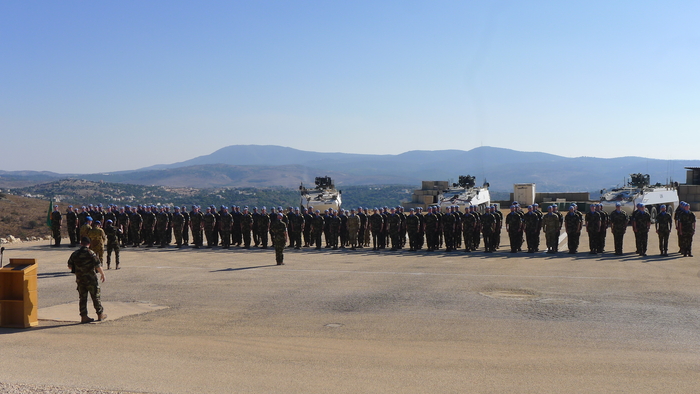
On a sunny, Mediterranean afternoon, a light breeze swept the soccer pitch-sized helipad, doubling up as a parade ground for the day, as the generals pinned medals on beaming young soldiers, to the strains of ‘Amhrán na bhFiann’ and the UN anthem, WH Auden’s ‘Hymn to the United Nations’. But once the PA was switched off after speeches, and a blessing of the gongs by chaplain Fr Paul Murphy complete, the buzz of a drone could be heard.
Israel’s Unmanned Aerial Vehicles and quadcopters have been a constant background drone during the seven-month deployment, now nearing its completion in November. Morning, noon and night, they have been buzzing around and over the camp. So much so, that many soldiers have simply got used to it. Others have designed catapults and water jets to deter them. They have nothing else.
The Galway Advertiser witnessed one small, rugby-ball-sized drone hovering close to the perimeter of the camp, and a larger Elbit Hermes drone with a wingspan of 15m – capable of carrying missiles and sophisticated surveillance technology – loitering high above. Smaller quadcopters have lingered around outposts almost daily.
However for Corporal David Casserly, from Westside, it was a different experience two weeks ago, when an Israeli drone dropped stun grenades barely 20m away from a patrol he was leading. They were tasked with watching over local contractors clearing rubble from a road.
His immediate response was to check and ready his men, ensure the “shook” construction crew were okay, and immediately report the incident back to base. His report travelled rapidly up the command chain, prompting UNIFIL’s HQ to send a deconfliction request across the Blue Line, the de facto border which separates south Lebanon from Israel.
Policy of harassment
According to Lt Col McDonagh, “constant harassment” by Israeli drones during this deployment must be assumed to be IDF policy, not local commanders gone rogue. Soldiers have also recently “painted” Irish troops with their rifles’ laser sights, a form of intimidation which could justify a hot response, but the Galway-led contingent is under orders to deescalate.
Each time Israeli troops rotate at nearby mortar positions, they fire a few random rounds to bed in the tube. They can fall anywhere; at least two have landed next to the Irish base during 126’s tenure. Drone fired missiles have hit indeterminate targets just northwest of the camp.
Israeli artillery has also been firing illumination rounds at low trajectories during daylight. When the white-hot phosphorous lands, it sets tracts of summer-dry vegetation alight on the slopes of nearby hill farms. Engineers recently built concrete T-walls and berms along the Blue Line, including gates wide enough for a Merkava main battle tank.
Surveillance photos seen by the Advertiser show several large, compacted earthen carparks constructed just behind Israeli lines. The fear is that these are vehicle staging posts for another possible invasion from Lower Galilee, just like last autumn’s. Israel reported it lost 56 soldiers, and despatched 3,800 Hezbollah. Lebanese authorities said 2,700 were killed, mostly civilians.
Soldiers from Galway say they have felt the shockwaves of Merkavas firing their main armament next to their outpost, and the thunderclaps of airstrikes have rippled through the thin-skinned prefabs where personnel sleep. Heading home soon is an attractive proposition.
McDonagh says his troops have found more than 10 stashes of Hezbollah small arms during this deployment, and boxes of largely unusable ordinance in creeks and caves. He thinks it unlikely the militant group, which claims significant but dwindling support in Shia communities across rural south Lebanon, has heavy weaponry in this area.
Rocket launchers have been moved elsewhere since the short-lived war last October, when Israel attacked Iran, prompting Hezbollah, its ally, to strike Israeli-occupied Syria. Israel’s response caused widespread destruction throughout southern Lebanon. Forces of the new Syrian government said it intercepted anti-tank missiles – likely Hezbollah’s – at its border last week, while some units of the Lebanese army can be slow to collect militants’ stashes discovered by the Irish.
Although nothing compared to images of the annihilation of Gaza broadcast since October 2023, seeing first-hand the levelling of homes and other buildings by Israeli airstrikes is a shock. No refunds, no reparations, no response. Just rubble, where a family once grew up together.
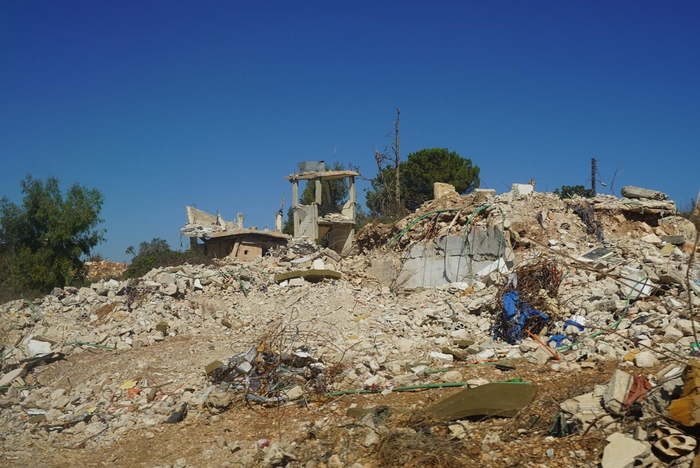
Local people noted that in the past, the IDF bombed buildings somewhat surgically, especially homes evacuated by families, perhaps temporarily occupied by Hezbollah militiamen. Now they are using bigger bombs, which either destroy or severely damage nearby properties also, wrecking sensitive sites, such as schools, clinics, mosques and generational graveyards.
Half-finished, modern homes, which would not look alien in a swanky Galway suburb, lie abandoned, as builders fear their plant will be targeted. Mini diggers and JCBs are squirreled away under bridges and beneath flyovers. Unpicked litter builds by the roadsides.
Speaking on the phone, ‘Sara’, a lifelong inhabitant of a Christian village in southern Lebanon, said she always felt safer from airstrikes than her Shia neighbours, the next valley over, but since the Israeli airforce bombed a Maronite Catholic town last October, killing 24 civilians including two small children, that assumption is no longer sound.
Recently widowed, she intends to sell her grandfather’s land to cousins, board up the house for a hopeful future return, and move to her sister’s home in Detroit after Christmas.
“Maybe I will visit [Galway] one day, to see your sea, and see your soldiers playing with their children, and hope that my beautiful country – at peace – will never need them to come here again.”