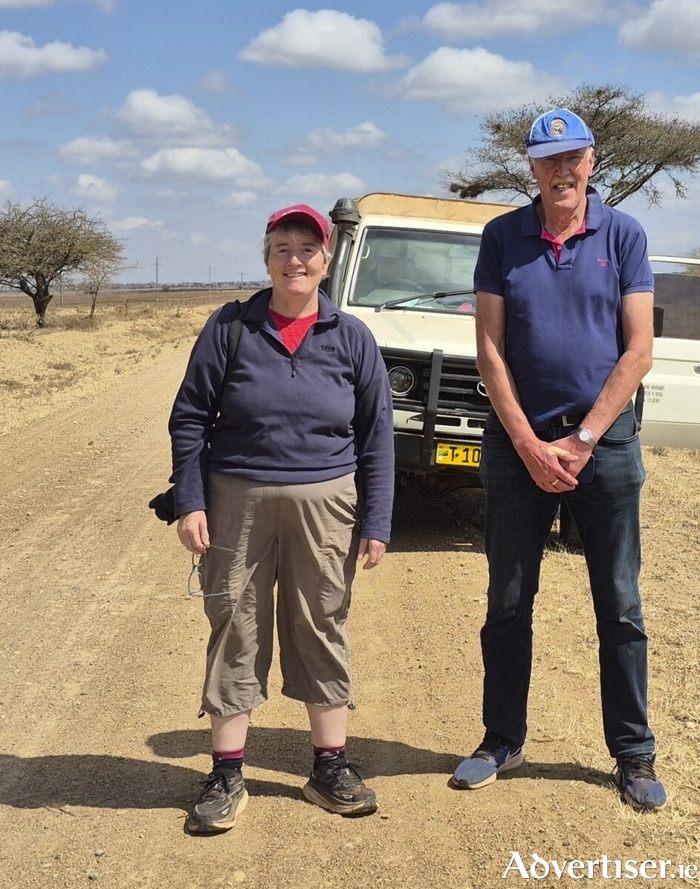
Christy O’Hara and Martina Farragher will never forget the sheer joy on the Tanzanian children’s faces when they saw balloons for the first time. Their eyes opened wide with excitement as they were inflated and then released into the air. The atmosphere was electric as they chased them around the place, shrieking with delight.
The two Galway volunteers had brought them gifts of footballs, sweets, and balloons when they visited their parish in Simanjiro in August. Local businessman, Christy, who lives in Claregalway and is a former head of human resources at Galway University Hospitals, and Martina, a nurse at University Hospital Galway who is from Athenry, were representing the local charity, the Athenry Simanjiro Parish Partnership. She is the current chairperson of the organisation.
Before the summer of 2005, few people in Athenry had heard of Simanjiro, a remote underdeveloped area in northern Tanzania, one of the largest countries in East Africa – it is more than ten times the size of Ireland – and one of the poorest in the world. Nuala King set up the charity that November in partnership with her own parish in Athenry and the Divine Word Missionaries (DWM ) who run the African parish and its local hospital.
She had earlier volunteered in Tanzania as a teacher. She was initially struck by the then lack of electricity and water, the dirt tracks that served as roads, the small mud huts that were people’s homes, and the zebras, gazelles, and ostriches who wandered through this barren landscape. “It was a sight to behold,” she wrote in a fundraising book about the partnership.
Thanks to the support of a hardworking committee in her parish and the generosity of the Athenry people, more than €300,000 has been raised for the region. This has funded essential services such as clean water, and medical and educational facilities for the people who live in this remote bush area.
Over 90 per cent of them belong to the semi-nomadic Maasai tribe whose lifestyle centres around cattle herding. A scarcity of food and clean water and a low standard of healthcare are among the problems that beset the area. The arrival of electricity in 2021 was a major boost, it is dark from 7pm to 7am throughout the year. Preventable diseases are rampant and it is believed that more than 25,000 women die annually from pregnancy related issues. Health problems range from snake bites and tuberculosis to malaria and dysentry. HIV and AIDS claim many lives but these are neither spoken about nor recorded.
Martina Farragher says Simanjiro people would have “nothing” without the generosity of Athenry locals. Since the charity was set up 20 years ago, it has dug a well (people travel miles to fill their containers ) and provided a water scheme. It also upgraded a hospital (it built two new wards and an operating theatre and provided it with surgical equipment and an X-ray machine ). Furthermore, it sent a 40-feet truck carrying an ambulance, hospital beds, sheets, blankets, equipment, medicines, and educational supports. And that’s not all; it also built a parish church, supported outreach mother and baby clinics, and established a home in Nairobi for 24 street children.
Healthcare backgrounds
“We, as a committee, decide what’s a priority. Fr Lawrence Muthee, the parish priest there is from Kenya and he tells us what is needed. Every penny is accounted for. There is no middle man, it’s just us [the charity] and the people in Tanzania. The volunteers pay their own expenses.
“Christy and I went there recently to see how things were going,” says Martina, who has been involved with the organisation since 2017. Both their healthcare backgrounds were invaluable when it came to determining future needs. She says currently there is no need for any further construction work and the charity is concentrating on maintaining what it has and funding education initiatives. And most of all, saving lives in the hospital. Minor, easily treated conditions that are neglected can result in serious illnesses and endanger lives.
Often, attending hospital is a last resort as local people often rely, to their detriment, on witch doctors for cures because the service is free. “Sadly, some women who are having a baby, for example, may die at home because of the delay seeking help.”
The hospital charges a small fee but people are reluctant to pay it, she says. “The men hate parting with money.” Their main income source is livestock and they place great value on their goats, sheep, and cattle and are loath to sell any to fund medical treatment, even if a family member is seriously ill. It is said that the Maasai love their cattle and sometimes the best looking ones remain in the herd until they die. The men follow their animals for miles seeking grazing land and water.
The rest of the time they sit around in the sunshine, drinking very sweet milky tea (or something stronger – liquor dens operate openly in shacks ) from tin mugs, handed to them by the women! They do everything – building their mud-clad huts, cooking, milking the cows, fetching the water, gathering sticks, and rearing the children. The little ones often act as mini-mothers, carrying their siblings on their backs or bringing big buckets of water from the well.
Christy O’Hara, says some, particularly the clever ones, are taken out of school before they are eight years old to look after the cows and goats all day. The fathers know they are wise enough to be entrusted with protecting their valuable stock.
He says when he visited the hospital it was great to see the line-up of African women waiting to get their children vaccinated. “It is located in a big compound and was very basic originally. UHG sent some equipment out, and the university was also involved. Mostly, they have everything they need in the 12-bed hospital for the services they provide. It now has a lovely operating theatre but the challenge is getting anaesthetists and radiologists.
“When my daughter, Claire, was in fourth year of her nursing degree, she got the option of going to a developing country and she went to Tanzania in 2019. She spent about five weeks there and loved it. She’d go back again. She said people valued what you did for them.”
Constant drought
Christy, who works as an executive career coach, specialising in sport to business transition coaching, says education and support is the key to overcoming many of the challenges facing Simanjiro women, in particular. Teenage girls being sold as child brides is commonplace. They can be as young as 14 and the men may be aged 50 to 60. Martina says there was a case where a 14-year-old girl walked 20 kilometres to escape her fate to a facility which offers education and training for such teenagers.
He was struck by the poverty of the region – it suffers from constant drought and is consequently parched – and the dominant role the men occupy in the culture. They hold the purse strings but do not appear to do much. “They only spend money as a last resort. A wife could be seriously ill, at death’s door with baby complications, but they would be reluctant to sell a goat – some would have 50 goats, others less than 10 – the priest would say they value the goat more than a woman.
“They can have as many wives as they want, one man had two wives and had five children with each of them.” In a startling contrast to the mud huts and the footwear the people wear which is fashioned from motorbike tyres, are the proliferation of mobile phones and scooters and the excellent Wifi in the bush.
Christy was tremendously impressed by the local priests. They are very hands-on (they fix trucks and roofs as well as attending to pastoral duties ), and are trying to empower women by encouraging them to set up small businesses, such as selling eggs. They also oversee the projects funded by the Athenry Simanjiro Partnership. He asked the priest there how he felt he’d make progress, and he said it would be through education.”
The partnership, started by a small group of Athenry people, is thriving today, 20 years after its foundation. “It was lovely to see how a partnership with a place can work so well. We saw where the money is being spent. The priest does a performance review of the staff every month, he interviews them on pay day and docks their money if they have not performed. That applies to the doctors as well as the labourers.”
What are his abiding memories of his time there? The colourful, usually red, robes worn by the Maasai and their beautiful singing voices, the encounter he had with a goat that was gifted to the local priest and that Christy presumed was dead, until he got a nasty kick from him, and the shepherd who slept with his flock in temperatures of up to 40 degrees. Coming face-to-face with giraffes and zebras and the image of the joy on the children’s faces when they saw balloons for the first time is etched indelibly onto his memory, too.
Christy and Martina say they both were hugely impressed by the Samanjiro people’s friendliness and positive attitudes. “They have very little but they are very content.”