Ballinrobe set for 'Dunk Tank' challenge
Fri, Aug 04, 2017

The people of south Mayo will have an unusual opportunity to 'dunk' their friends in the name of charity. A number of events will be held in Ballinrobe on Friday next, August 11, to raise funds for the LauraLynn Foundation. Stephen Cummins, who is originally from Caherlisterane but now living in Ballinrobe, came up with the idea having seen an item on television about the work the foundation do for young children with cancer.
Read more ...Mayo Pride Parade is another important step in our history
Fri, Aug 04, 2017
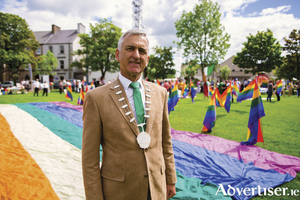
I was very disappointed to have missed the first Mayo Pride Parade in Castlebar on Saturday July22. I was out of the country but as soon as I got back I read the local papers' reports and contacted Mick Baynes, one of the event organisers, to get another view of what by all accounts was a well-attended day of good spirited solidarity. It is not that long ago when even the thought of such a colourful Pride parade through the county capital's streets would have met weighty and vociferous opposition.
Read more ...Ballina gears up for a weekend of food and more
Fri, Aug 04, 2017

The Food Fleadh Ballina makes a welcome return to the North Mayo capital from August 25 to 27 and over the weekend, visitors can enjoy a number of great family-friendly events including family foraging, food demonstrations, a ‘Ready Steady Cook’ competition, children’s cookery classes, the inaugural ‘Yeast Meets West’ Craft Brew fest, cocktail-making demonstrations by award-winning mixologists, featuring the finest spirits from Ballina’s Connacht Distillery - all while enjoying the finest of North Mayo food.
Read more ...A history of Reek Sunday
Fri, Jul 28, 2017
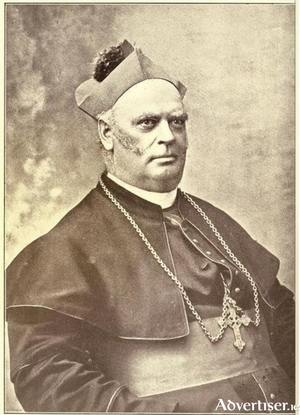
In 1432, Pope Eugene IV issued a document that lay in obscurity deep within the Vatican vaults for centuries. When the doors of the archives and library of the Holy See were thrown open during the papacy of Pope Leo XIII (1878-1903), the British government sent a team of historians to transcribe everything they could find relating to Ireland. As a result of that investigative trawl, the well-known historian William Henry Grattan Flood presented Dr John Healy, Archbishop of Tuam, with a medieval document that detailed Rome’s official 15th century stance regarding the Croagh Patrick pilgrimage. The document, dated 27 September 1432, states, “Pope Eugene IV grants to the Archbishop of Tuam [at the time Seán Mac Feorais, aka John de Bermingham] an indulgence of two years and two quarantines [one quarantine was a penance of 40 days], on the usual conditions, for those penitents who visit and give alms toward the repair of the fabric of the chapel of St Patrick on the mountain which is called Croagh Patrick: this indulgence to be gained on the Sunday preceding the Feast of St Peter’s Chains [August 1]: because on that day a great multitude resorts thither to venerate St Patrick in the said chapel.” Archbishop Healy revived the old tradition of pilgrimage to Croagh Patrick and built the present church on its summit in 1905. But the history of the pilgrimage goes back further than the 1400s.
Read more ...Westport gears up for influx of Reek Sunday pilgrims
Fri, Jul 28, 2017
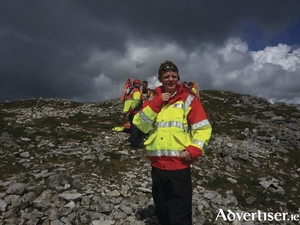
The annual influx of thousands of pilgrims to Mayo for Reek Sunday takes place this weekend - as the annual pilgrimage of Ireland's holy mountain (Croagh Patrick) takes place. Upwards of 25,000 are expected to climb the mountain, many of them travelling from locations all over the country.
Read more ...Number of families living in Mayo increased by 468 according to Census
Fri, Jul 28, 2017
The census that was carried out last year found that there are 33,628 families in Mayo, an increase of 468 (1.4 per cent) on the 2011 figure, according to the latest release of data collected.
Read more ...Lack of footpath and lighting to Behy NS raised
Fri, Jul 28, 2017

The cathaoirleach of Ballina Municipal District has described the lack of a footpath and public lighting on the road leading to Behy National School as appalling and in urgent need of attention.
Read more ...Lack of hedge cutting raises its head again
Fri, Jul 28, 2017
The need for Mayo County Council to cut back hedges and to trim verges along the main, non national roads in the Ballina Municipal District was highlighted by a number of councillors at a recent meeting of the municipal district.
Read more ...Claremorris Agricultural Show promises to be a day not to be missed
Fri, Jul 28, 2017
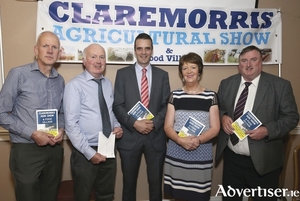
Once again the Claremorris Agricultural Show Committee is gearing up for their annual show – the 99th installment of which is to be held in Claremorris on Sunday, August 6 – making it one of the oldest shows in the country. At this stage they are looking forward to the 100th show and plans are in place for this major event next year. Last week, this year's show was launched by Joe Healy, president of the IFA. Mr Healy had encouraging words for the show and promised the committee he’ll be back next year for the 100th show.
Read more ...A sheriff once roamed these here parts
Fri, Jul 21, 2017
The High Sheriff of Mayo was the British Crown’s representative in the county from the post’s creation in 1583 until the establishment of the Irish Free State in 1922. In a country where ownership of land carried huge prestige, the landed had to protect what they held by securing positions of power. So it was in County Mayo that the dominant families of Browne, Bingham and Gore isolated the role of High Sheriff largely for themselves up until the 19th century at least, from which time family names such as O’Donel, Knox, Blake and others appear in the records as holders of the office.
The High Sheriff was the principal representative of central government in the county in relation to the execution of the law. The position developed to include selecting the county grand jury (a precursor of the county council) and supervising parliamentary elections. In the early decades of the 1800s polling took place over a number of days in one location in the county. Under the Reform Act of 1832, five days were allowed for Irish county elections. This was reduced to two days in 1850 and finally one in 1862. Making sure elections ran unhindered was a large undertaking for the High Sheriff and the military. It was estimated that in 1832 two-thirds of the total military force in the country was employed on election duty. Contested elections could all too easily turn riotous. In January 1835, the High Sheriff of Mayo, JN Gildea, wrote to the Under-Secretary for Ireland explaining that due to the many attacks at the last election, he was suggesting that ‘three troops of cavalry, and five of infantry, together with the police, will not, in my opinion, exceed that which may be required to protect freeholders, and keep the peace’.
Read more ...The history of Lough Mask through its own isles
Fri, Jul 14, 2017
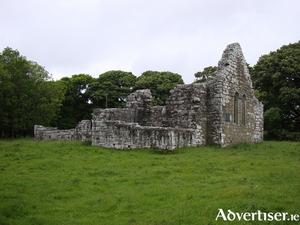
Throughout the centuries the islands of Lough Mask have stood silently and helplessly by as they played host to many extraordinary events. This week I am able to touch on just some of those events chronologically.
Read more ...The Protestant enclave of Inishbiggle
Fri, Jul 07, 2017
In the 1650s, Catholics were uprooted from their productive, arable, lands in several Irish counties by Oliver Cromwell’s Protestant army and forced at musket point to desolate, barren, Connacht. Their confiscated lands, the better holdings in Ireland, were distributed to Protestant settlers, Cromwell’s army as pay, and carved up to pay debts. Maps of Ireland, pre and post Cromwell, detailing the regression of the predominantly Catholic associated Irish language and customs point to a culture that was deliberately and officially forced to areas thought of as being so inhospitable they would not survive. County Mayo was included among these religious and cultural ghettoes. The living standards of the banished Catholics fell dangerously low and remained so for centuries. Christian duty led some within the Protestant clergy to later establish evangelical missions in the wild Irish west to give relief to the descendants of those very same Catholics. Salvation and, dishonourably, food were offered through conversion to Protestantism. Whereas 17th century Protestants believed it was God's will that godless Catholics be sent to suffer and perhaps perish in Mayo, 19th century Protestants believed it was His will that these (still godless) Catholics be reclaimed so that they might be saved. The Rev Edward Nangle's Achill Island Mission set out to do just that in 1831.
Read more ...