Search Results for 'Persses Distillery'
6 results found.
The canal
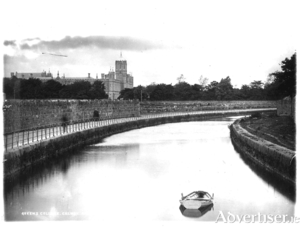
In 1872, SU Roberts, the Galway County Surveyor, wrote: “The lower lake empties its waters through a delta by three visible outlets: the natural and original shallow, tortuous and rocky Corrib River, navigable for only very small craft and row-boats on the west; the Mionloch Creek, a small stream, on the east and now nearly filled up; and through the boggy island covered with sedge between these two, by means of the “Friar’s Cut”, a canal of about three-quarters of a mile in length, fifty feet wide and twelve deep through the main stream passes. Besides these three streamways, there is a subterranean communication through the cavernous limestone, by means of ‘swallow holes’ near Tír Oileáin on the eastern shore which formerly carried off a large portion of the surplus waters of the lake, and discharged them into the sea near Oranmore”.
Reconstruction of the Galway Fishery
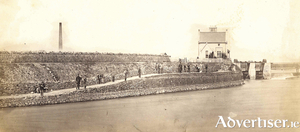
Based on the McMahon Report, a survey involving the engineers of the Commissioners of Public Works in consultation with local businessmen and anglers, works were undertaken to improve drainage, to facilitate navigation, and to provide waterpower to the many mills in Galway. Waterpower was the bedrock on which the industry of Galway city was based, and by the mid-19th century there were some 30 mills in the city with associated headraces and tailraces which resulted in an intricate network of small waterways, which greatly added to the charm of Galway.
Persse’s Distillery
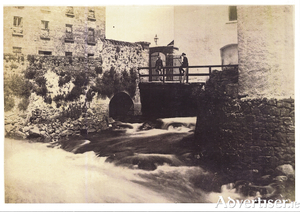
For much of the 19th century, the Persse family ran one of the most successful distilleries in Ireland. Their product became world famous. They were major contributors to the industrial life of Galway and provided much needed employment. In addition to their staff, they were also supplied by a number of artisans working in the Nuns Island area — coopers, cork manufacturers, printers, carters, case makers, etc.
Persse’s Distillery, Nuns Island
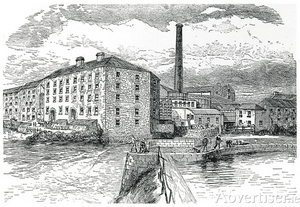
In 1840, the Joyce family offered their distillery at Galway for sale. It was described as follows: “That large and valuable distillery establishment at Nun’s Island, at presently occupied and worked by Messrs. James and Patrick Joyce. Within the walls that surround the distillery there is a mill to which there is a store capable of containing several thousand barrels of grain and two kilns, Queen’s warehouse spirit and barm store with various other offices and conveniences. The distillery contains a wash still of 5,000 gallons; a Low Wine still of 3,000 gallons; 3 brewing coppers fit to contain about 200 barrels each, 7 fermenting backs of 14,000 gallons each; One mash Kieve with machinery capable of mashing 200 barrels of grain, and a mill capable of grinding over that quantity daily.
Market Street, 1880, a bird’s eye view
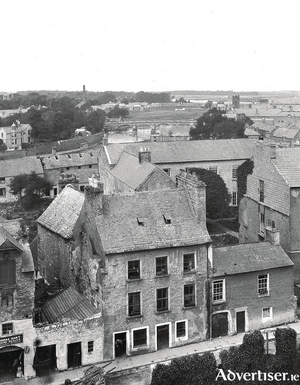
This photograph is part of the Clonbrock Collection in the National Library, and was taken from the tower of St Nicholas’ Church in 1880, looking over Market Street. This panoramic view extends as far as the river. The chimney you see on the horizon was that of Persse’s Distillery. In the distance (you probably will not be able to see it in this reproduction) is the Clifden railway embankment running along the river bank. The building that is now the County Club is near the top left of the picture, the tower of the Mercy Convent near the top right.
Galway Distillery tickets
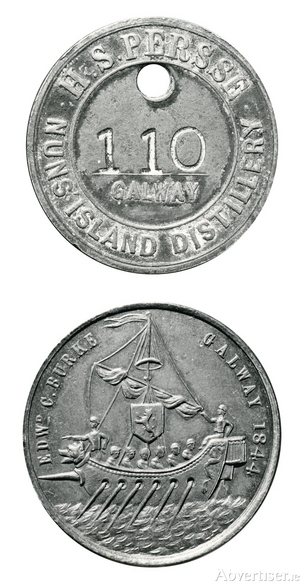
In the 1600s trade tokens were given out by the Crown and were used as a royal licence to do business. If you were a trades or business merchant, you had to obtain this token. Some had dates on them and some had not. In Galway city and county there were 43 merchants listed in the period 1653-1679. By 1680, many of these tokens were replaced by the halfpenny copper coin.