Search Results for 'Mill Street'
69 results found.
Pipe upgrade means five months of road works
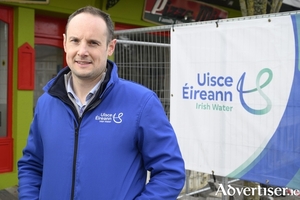
The good news for residents from Wellpark to the Docks is that a more reliable water supply is on its way, but the bad news for commuters is road works throughout the school term until past Christmas.
‘Robust’ policing for city centre

Garda Commissioner Justin Kelly is confident his new policy of saturating Galway city centre with uniformed gardaí will not push petty crime into the suburbs.
Galway City Council showcases protected structures on city approach roads
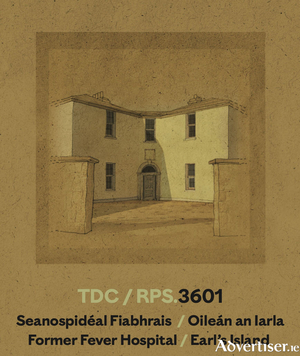
Galway City Council is bringing the city’s architectural heritage into the spotlight this April, with a new initiative showcasing buildings from Galway’s ‘Record of Protected Structures’ on 15 high profile road signs coming into the city.
O’Donnellan & Joyce presents an exquisite period home in the heart of Galway
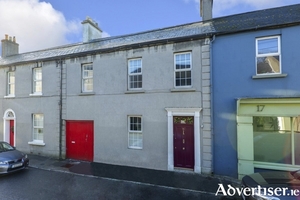
O’Donnellan & Joyce auctioneers presents to market for sale this exquisite period-style residence in the heart of Galway city.
British Ambassador’s Galway visit sparks strong reactions
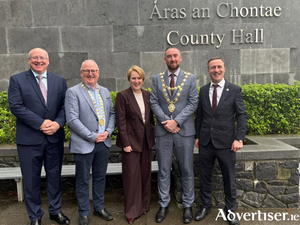
The recent visit of British Ambassador to Ireland, Kara Owen, to Galway prompted strong reactions at the November Plenary Meeting of Galway County Council, with Independent Connemara South councillor Tomás Ó Curraóin voicing firm objections.
Visitors stage anti-migrant march in Galway
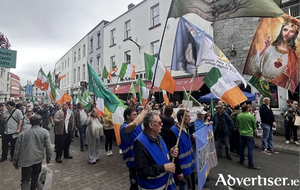
Around 60 marchers listened to speeches by the playground of Fr Burke Park in the Claddagh, before parading through town to Prospect Hill, behind Irish, Ivory Coast and Offaly flags, shepherded by a heavy Garda presence.
The turf market
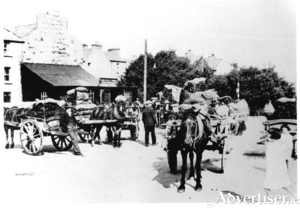
James Hardiman, in his history of Galway lists the fuels available in Galway long ago as coal, turf and bog deal. Bog deal was mostly the roots of trees that had been grown over by the bog over the centuries. It was regarded as a nuisance by the turf cutter who likes nice clean lines as he used his sleán. The turf men usually threw this timber up on top of the bog. It gave out a lot of sparkle, like a mini firework, while it burned in the grate.
Volunteers needed at SVP Galway

The Society of Saint Vincent de Paul has twenty-two local Conferences in the Galway area. They meet weekly and respond to the many and diverse requests received; these may be due to a family illness, loss of a job, poverty struggles, debt arrears, financial difficulties or other unforeseen circumstances.
Galway hospitals
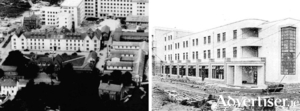
We know there was a hospital in High Middle Street in 1509, though it was probably a poorhouse in reality. In 1542, the Corporation built St Bridget’s Hospital on Bohermore. It subsequently served as a Leper Hospital. The 1651 map of Galway shows four hospitals. In 1820, a fever hospital opened on Earl’s Island, and in 1824, a small lying-in hospital was established on Mill Street at Madeira Island. The County Infirmary opened on Prospect Hill in June 1802.
Walkin’, talkin’ and touchin’
‘Mate’ Lydon was a Galway original, a character, a champion salmon snatcher and a great judge of porter. He was born in Rope Walk in the Claddagh in 1908. His name was Martin Lydon, but because he spent much of his childhood in his grandmother’s house, he was known locally as Máirtín Harte. He attended the Claddagh National School. He loved hurling, became a very good soccer player and was a regular on the famous Claddonians team which won the first ever Schweppes Cup in 1937. Our first image shows that team: seated Joe Flaherty, Jack O’Donnell, Martin Lydon, Bob Cantwell, Gus Flaherty, Thomas Lydon. Standing are Jimmy Connell, Martin Connell, Paddy Cubbard, Dick Ebbs, Jack Connor, Frank Fitzgerald and Eddie Cloherty. Mate usually played full back, and opposing forwards often found they had to take ‘the long way round’ to the Claddonians goal.