Search Results for 'Michael Brennan'
15 results found.
Reunion of the Bish classes of 1965 and 1966
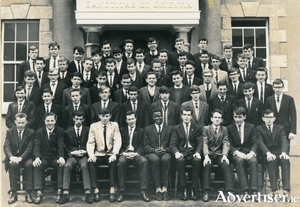
Two hundred years ago, in October 1826, the Warden of Galway wrote to the Superior of the Patrician Brothers asking him to send at least one Brother to Galway to take over a school which had been moved from near the Shambles Barracks to a disused barrack in Lombard Street. Brother Paul O’Connor and Brother Dawson were sent to Galway. Cash in hand was one shilling. Social conditions were very bad, but the Brothers went ahead and established the Monastery School, known as The Mon. Before the school had been a year in operation, the improvement in the youth of the city was so evident that a public meeting was held in the school to vote thanks to the teachers, “whose zeal, attention and excellent arrangements had produced such happy results”.
The men of ‘34
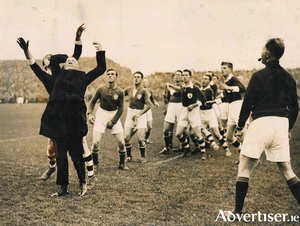
There has been so much hype recently about how Galway had not beaten Dublin in football for 90 years that it got me wondering, what were those men of 1934 like? They must have been mighty men. They were! This is who they were –
Glenina Vets expansion ushers in new era for pet care in Galway
A cornerstone of veterinary care in Galway for nearly 40 years, Glenina Vets has future proofed its service for future generations of pet owners, by introducing new innovative equipment, renovating the current practice space and adding highly specialised veterinary staff to its team.
Swimming in Salthill

Swimming is the self-propulsion of a person through water as a form of recreation, exercise or survival. It has numerous health benefits and is good for all ages and all levels of fitness. It is among the top public recreational activities. One can swim in the sea, the lake or river.
‘The girl we left behind us’
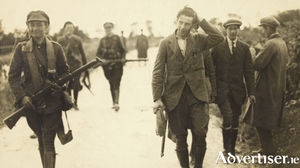
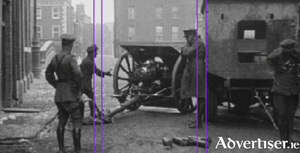
In the immediate aftermath of the recapture of Clifden by the anti-Treaty forces on Sunday 29 October 1922, the town was in a mess. Every house on Main Street had its windows and doors shattered. The streets were littered with glass as a result of explosions. In the houses opposite the barracks ‘not a picture remained on the walls, nor a piece of furniture unscathed’. Porter and spirits ‘flowed out the door’ of Lavelle’s pub. The ‘armoured car’, which had caused so much surprise, and gave cover to allow bombs to be placed, was removed and abandoned at Killery. It was noted that for the first time in living memory there were no church services in Clifden that Sunday.
Anti-Treaty forces ‘secret weapon’ helps recapture Clifden
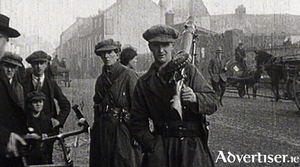
On Saturday night, October 28 1922, a large force of anti-Treatyites made their way carefully and with as little noise as possible, into the silent streets of Clifden. They had already ‘taken’ Clifden the previous July, but were unceremoniously driven out by the National Army who approached Clifden by sea achieving total surprise.
Monsignor McAlpine would not take orders from boys he had baptised
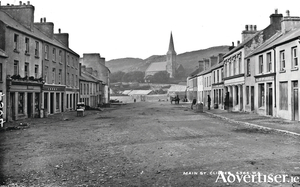
After sporadic fighting in Galway during the summer of 1922, and the occupation of some buildings in the town, including the old RIC barracks in Eglington Street, and the former Connaught Ranger barracks at Renmore, the anti-Treaty forces withdrew into Connermara, and into the east Galway countryside.
Santa Claus comes to Galway
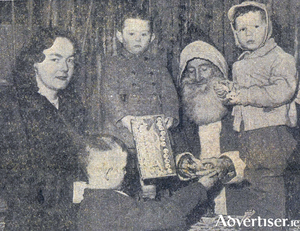
St Nicholas of Myra is the patron saint of archers, sailors, merchants, repentant thieves, brewers, pawnbrokers, unmarried people, students, and children. He is also the patron saint of Galway, and our oldest church, St Nicholas' Collegiate, is named after him. He was a legendary giver of gifts, particularly to the poor. He would hand coins in through windows or open doors, and if they were closed, sometimes he would put them down the chimney. This was the origin of the tradition of Santa coming down the chimney bearing gifts. The tradition was good for business for chimney sweeps, it would be difficult to explain soot marks on the floor on Christmas morning.
Tobar Éanna, St Enda’s Well, Barna Woods
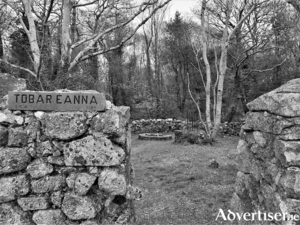
In many cases, ancient folklore linked holy wells with a god, a goddess, a mythical creature, or a serpent; they were places of pagan worship which were at odds with Christianity. Ever since medieval times, efforts have been made to stop well-worshipping and to Christianise them. Many townlands have a water source that has been marked out for special devotion, most of them being allied to a particular saint. These are usually sanctuaries within the landscape, threshold sites that enable us to step back from the hullabaloo of daily existence and allow us to access something grander and otherworldly, something infinite and unknown.