Search Results for 'Sergeant'
108 results found.
Boarded-Out Children

Sarah Shaughnessy was ten years old when she gave evidence and allowed herself to be subjected to cross-examination in the trial of William and Margaret Roche at Castlebar Petty Sessions on 14 June 1916. The case is remarkable for Sarah's courage and the insights it gives us into the system of boarding out workhouse children.
Steamer’s Quay
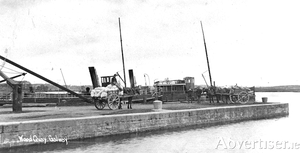
Alexander Nimmo made a survey of Lough Corrib almost 200 years ago in which he wrote the following: “The lake has 50 miles of shore, occupies 30,000 Irish acres and contains 1,000 acres of arable land in its isles, and contracts into a very spacious river about two and a half miles above Galway, which, flowing by the town, communicates with the Atlantic. The fall from the summit of the lake to the sea is considerable, but to the Wood Quay, above the town, it is trifling, and the river is in parts very shallow, running over a bed of rocks and hard gravel. It is not navigable from the sea to the Wood Quay owing to its shallowness and the rapidity of the water, and none but small boats can come down; but unless in very dry seasons, it is thence navigable by boats drawing four feet of water and carrying from ten to twenty tons, with one square sail and four men, to Cong. They seldom sail, unless before the wind, and though the lake has many islets and sunken rocks, the only serious difficulty in navigation is at Buachally Shoal about four miles up the lake, and at Newcastle. These shoals could be deepened for a small sum and the whole made to admit vessels of much greater magnitude. The fine navigation which extends about 30 miles, and into a seaport town, seems to deserve more attention than it has yet received. A good chart with soundings and sailing instructions should be published, the shoals or rocks cleared or beaconed, and a communication opened with the sea.”
The legend of the last battle in Connemara
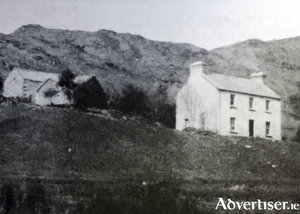
During the war of Independence the West Connemara IRA brigade, under the command of Petie McDonnell, was an effective and disciplined force. It had moved its headquarters to the Muintir Eoin residence of Pádraic Mór Ó Máille, a two-storey farmhouse, backed by rock and heather covered hills, which stood on a small rise, along the Maam to Leenane road. It offered commanding views of the Maam Valley.
The legend of the last battle in Connemara
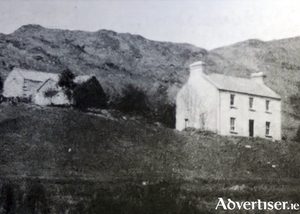
During the war of Independence the West Connemara IRA brigade, under the command of Petie McDonnell, was an effective and disciplined force. It had moved its headquarters to the Muintir Eoin residence of Pádraic Mór Ó Máille, a two-storey farmhouse, backed by rock and heather covered hills, which stood on a small rise, along the Maam to Leenane road. It offered commanding views of the Maam Valley.
Hotel67 at The Gleneagle
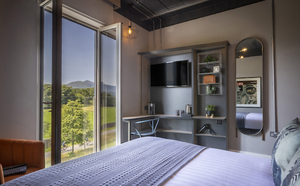
Hotel67 - a new, unique boutique style hotel located within the grounds of the iconic Gleneagle Hotel recently opened its doors.
Hotel67 at The Gleneagle — something different is happening in Killarney
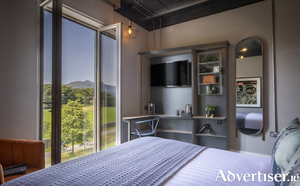
Hotel67 - a new, unique, boutique style hotel located within the grounds of the iconic Gleneagle Hotel, recently opened its doors. This new concept, a hotel within a hotel, means guests can enjoy the quirkiness and intimacy of Hotel67 while still having access to the great leisure, dining and entertainment amenities of The Gleneagle. It is also the perfect place to stay when taking in a gig at The Gleneagle INEC Arena or INEC Club.
Local Gardai appeal for assistance following recent Crescent store robbery
Local Gardai have appealed for the public’s assistance following a robbery which took place in the heart of Athlone on Friday evening last.
An Garda Síochána, the early years in Galway
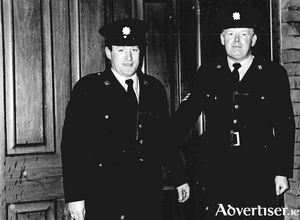
After the truce, the RIC handed over its barracks to the Irish Free State. One hundred years ago this month, the Government set up An Garda Síochána, an unarmed civic police force. Unfortunately, the first group of gardaí who arrived in Galway by train had no barracks to go to, the Eglinton Street headquarters having been destroyed in an arson attack. A search began for some place to house the 23 gardaí and that evening, they managed to find accommodation in the County Club. They stayed there for almost a year.
The RIC in Galway
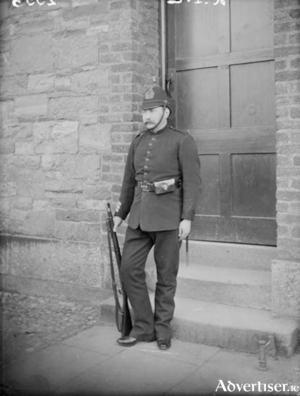
In the 18th century, attempts at maintaining law and order in Galway were poor. Occasional groups of civilian vigilantes were set up, but they were not very successful. Then, 200 years ago, in 1822, the Chief Secretary Henry Goulburn set up the Irish Constabulary. In 1824, Edward Blake from Mary Street became the first Catholic in Ireland to become a constable. In 1825, a decision was made to bring police to Galway. Some time later a barracks was set up in Abbeygate Street, then one in Eyre Square (where Giblin’s Hotel was situated later), and one in Dominick Street where An Tobar Nua is today. The force gradually became very organized, was successful in dealing with crime, and so Queen Victoria granted it the term ‘Royal’.